Radiology teams lose hours each week when imaging systems go down or images transfer slowly between locations. Some platforms still require on-site servers that create single points of failure during outages.
This article explains the infrastructure choices that support continuous uptime, details Medicai's cloud model and disaster-recovery setup, and compares cloud PACS with zero-footprint viewers against traditional alternatives. Readers will finish with a clear picture of which teams benefit most from the listed security and compliance standards.
What Is Medicai?
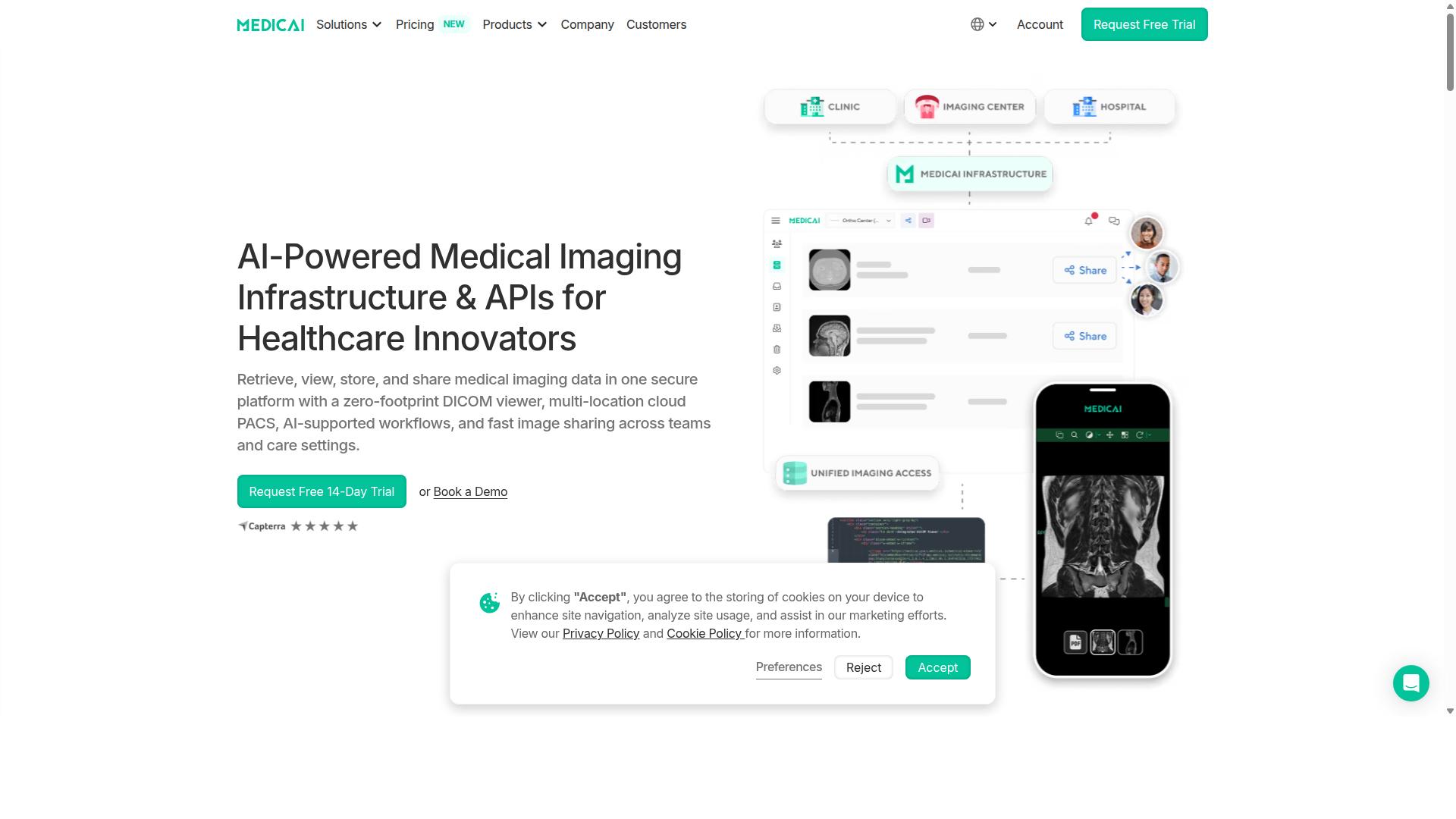
First sentence: Medicai is a cloud-based medical imaging platform that enables healthcare providers to retrieve, view, store, and share medical imaging data in one secure platform with a zero-footprint DICOM viewer.
The platform offers imaging data management, secure sharing features, and zero-footprint viewer access. These capabilities help healthcare organizations consolidate multiple radiology IT functions into one cloud environment.
Medicai provides Imaging Infrastructure as a Service and supports multi-location cloud PACS. The system includes AI-supported workflows that assist radiologists across different care settings.
Healthcare providers worldwide can access the platform for fast image sharing across teams. The service operates as a VC-backed healthcare startup focused on modernizing medical imaging workflows.
Medical facilities gain improved interoperability through this unified approach to radiology IT. The platform serves enterprise radiology environments that require consistent system reliability and data security.
Why Medicai Delivers High-Availability Radiology Platforms
High availability in radiology platforms requires multi-layer redundancy, geographic distribution, and robust failover mechanisms that eliminate single points of failure.
Continuous access supports radiologist workflow and reduces delays in patient care. Any interruption in image retrieval can delay diagnosis and treatment decisions across multiple hospital departments.
Medicai maintains high uptime through its cloud infrastructure and data protection services. The platform combines Microsoft Azure and Amazon AWS resources to support enterprise radiology environments that demand constant availability.
This approach ensures medical imaging remains accessible even when individual components experience issues. The system supports teleradiology workflows that require reliable access from different locations.
Multi-Region Cloud Infrastructure
Multi-region cloud infrastructure distributes DICOM study storage and processing across geographically separated data centers to maintain access during regional outages.
Medicai deploys its Cloud PACS across multiple availability zones in both Microsoft Azure and Amazon AWS. This distribution protects against localized failures while supporting image archive operations.
Load balancing directs image retrieval requests to the nearest available region. The system monitors performance and automatically routes traffic to optimal locations based on current conditions.
Automatic failover routing redirects traffic when regional issues are detected. This process happens without user intervention and maintains continuous availability for active sessions.
Bandwidth optimization reduces latency during teleradiology workflows by prioritizing data transfer efficiency. The system adjusts transmission rates based on network conditions and file sizes.
Medical imaging studies move between regions as needed while maintaining image quality. This capability supports real-time access for radiologists working across different time zones or locations.
Disaster Recovery and Backup Architecture
Disaster recovery architecture maintains synchronized copies of every DICOM study across different availability zones with automated backup verification.
Medicai performs automated backup for all stored medical imaging data. The Vendor Neutral Archive enables instant restoration from any location through its distributed storage design.
Recovery time objective stays under a short timeframe for most restoration scenarios. Point-in-time recovery allows selection of specific backup versions when needed for clinical review.
Encryption protects patient data both at rest and during transmission between backup locations. All backup operations include verification steps to confirm data integrity before storage completion.
The Backup and Disaster Recovery service integrates with the main platform to support continuous availability requirements. Role-based access controls limit which users can initiate recovery procedures.
Audit logging tracks all backup and restoration activities for compliance purposes. This documentation supports regulatory requirements while maintaining system reliability across the entire infrastructure.
Key Features That Support High Availability
High-availability features must integrate seamlessly with existing radiology workflows while maintaining instant access to studies regardless of system load or location.
These features focus on three core areas that directly impact system reliability and workflow continuity. Cloud infrastructure handles data distribution across multiple locations while maintaining consistent performance during peak usage periods.
Vendor neutral archive capabilities standardize data from various modalities into a single accessible format. Browser-based viewing tools ensure radiologists can access diagnostic images from any approved device without requiring local software installations.
Structured reporting templates maintain workflow consistency across different users and locations. These elements work together to reduce downtime risk by eliminating single points of failure and enabling automatic load distribution when demand increases.
Cloud PACS and Vendor Neutral Archive
Cloud PACS combined with vendor neutral archive creates a unified storage layer that eliminates PACS vendor lock-in and ensures study availability even during system migrations.
Cloud PACS handles over one million studies transacted annually with automatic load distribution across connected locations. This approach maintains consistent performance regardless of study volume or user demand at any given moment.
Vendor neutral archive standardizes DICOM data from multiple modalities into a consistent format that remains accessible across different systems. Real-time synchronization ensures that updates appear immediately at all connected locations without manual intervention.
Integration with existing RIS systems occurs through standard API connections that support fifty million yearly transactions. The Microsoft Azure partnership provides the underlying cloud infrastructure that supports this level of data exchange and storage capacity.
Backup and disaster recovery features protect against data loss while maintaining continuous availability for the seventy clinics and hospitals currently on the platform. This architecture supports the two million imaging studies already uploaded to the system.
Zero-Footprint DICOM Viewer and Structured Reporting
Zero-footprint viewers eliminate installation requirements and enable radiologists to access studies from any approved device with full diagnostic quality within seconds.
Browser-based access removes the need for local software installation while maintaining diagnostic image quality across different devices. The mobile-optimized interface supports on-call radiologists who need access outside traditional hospital settings.
Structured reporting templates maintain workflow consistency across different radiologists and locations. These templates standardize report format while preserving the flexibility needed for various imaging modalities and clinical scenarios.
The viewer supports over three hundred thousand monthly DICOM visualizations with full diagnostic capability. FDA and CEE cleared viewers ensure compliance with regulatory requirements while meeting the security standards set by HIPAA and GDPR guidelines.
Role-based access controls and audit logging protect patient data while enabling the ten thousand active doctors on the platform to collaborate on cases. This approach supports teleradiology workflows without compromising data security or system performance.
Pricing and Plans
Transparent monthly pricing tiers scale storage capacity and connected locations according to radiology department size and teleradiology requirements.
The Starter plan at $249 per month provides 500 GB of cloud storage with unlimited user accounts and no connected locations. Small practices can start with this tier to manage local imaging needs without additional infrastructure costs.
The Standard plan at $749 per month includes 2 TB of cloud storage, unlimited user accounts, and one connected location. This option supports growing departments that need to link a primary site with external radiologists or partner facilities.
Unlimited user accounts across both plans allow entire departments to access the platform simultaneously. Multiple radiologists, technicians, and support staff can work within the same system without per-user fees or account restrictions.
Enterprise customers receive custom pricing that accommodates multiple connected locations and external partnerships. Health systems managing several sites can scale storage and connectivity as their network expands.
Yearly billing reduces costs by fifteen percent, bringing the Starter plan to $209 per month and the Standard plan to $639 per month. Organizations with predictable usage can lock in these savings while maintaining flexibility to upgrade later.
A one-time $1,000 DICOM Gateway setup fee applies per location when connecting new sites. This covers the technical integration required to establish secure DICOM communication between facilities.
Enterprise customers can also explore per-study pricing models. This approach aligns costs with actual imaging volume rather than fixed monthly storage commitments.
The fourteen-day free trial includes all Starter plan features with no credit card required. Teams can evaluate the platform's high-availability capabilities before committing to any billing cycle.
Trust Signals
Trust signals in healthcare platforms must demonstrate both regulatory compliance and measurable performance benchmarks that validate system reliability.
Enterprise radiology departments require platforms that prove their commitment to data protection through recognized certifications. These signals help decision makers evaluate whether a solution meets the strict standards needed for medical imaging workflows.
Performance metrics further strengthen platform credibility by showing consistent operation at scale. Hospitals and clinics seek evidence that systems can handle large volumes of studies without compromising availability or security.
High availability radiology platforms must maintain continuous access to medical imaging data. Trust signals provide the documentation needed for procurement teams to approve technology investments that support critical patient care decisions.
Compliance, Security, and Performance Metrics
HIPAA and GDPR compliance combined with FDA/CEE cleared viewer establishes the regulatory foundation required for handling protected health information in radiology workflows.
These compliance frameworks mandate specific controls for patient data management. HIPAA governs healthcare data handling in the United States while GDPR applies to European patient information. Both require documented procedures for data access, storage, and transfer.
Encryption protocols protect data at rest and during transmission across networks. Role based access controls ensure that study visibility remains limited to users with appropriate credentials and clinical responsibilities.
Medicai demonstrates system scale through 50M+ yearly API transactions processed across its platform. This volume indicates reliable performance under enterprise level demand from radiology departments handling daily imaging workflows.
The platform maintains HIPAA and GDPR compliance while providing FDA/CEE cleared viewers for medical imaging review. These certifications support secure data handling across 70 clinics and hospitals currently using the system.
Over 10,000 active doctors access the platform for medical imaging needs. The system processes more than 1M studies per year and stores 1.7M studies in total, showing consistent operation at clinical volumes.
Who Should Use Medicai
Healthcare providers managing high imaging volumes across multiple specialties require platforms that maintain availability while supporting diverse workflow requirements. Medicai serves this need by delivering reliable access for hospitals, imaging centers, and specialty practices. These organizations depend on medical imaging for critical decisions.
Hospitals benefit from consistent platform access when coordinating care across departments. Multiple specialists review the same studies simultaneously. This setup supports timely treatment planning without delays from system interruptions.
Imaging centers handle large patient volumes daily. They need stable access to image archives and quick retrieval for radiologist review. Medicai supports these operations through its cloud infrastructure design.
Orthopedics practices rely on imaging for surgical planning and post-operative assessment. Orthopedic surgeons need reliable access throughout their workflow. Neurologists use similar imaging for stroke evaluation and treatment decisions.
Oncology centers require continuous access to imaging for treatment monitoring. Tumor boards depend on shared image review for collaborative decisions. Radiology departments maintain their core operations through consistent platform availability.
Cardiology practices review cardiac imaging for urgent interventions. Ophthalmologists need stable access for retinal analysis. OB-GYN clinics monitor fetal development through consistent imaging review.
Pulmonology practices depend on chest imaging for respiratory conditions. Dentistry practices utilize imaging for treatment planning. Gastroenterology centers require reliable access for diagnostic procedures.
Virtual care providers and telemedicine platforms extend their reach through stable imaging access. Teleradiology services maintain operations across time zones. Personal injury lawyers review imaging for case documentation. Clinical trials and medical education organizations also depend on continuous platform availability for their specialized needs.
Final Verdict
The platform's combination of multi-region infrastructure, disaster recovery protocols, and compliance certifications creates a high-availability solution suitable for enterprise radiology deployments.
Small practices benefit from cloud infrastructure that removes the need for local servers while maintaining access to imaging studies. Medium-sized groups gain scalability that matches growing scan volumes without hardware upgrades.
Larger institutions rely on multi-region deployment to support distributed teams handling high volumes of DICOM images. All practice sizes share the same foundation of redundancy and fault tolerance that protects continuous availability.
Evaluation begins with a technical review of current radiology IT systems and uptime requirements. Teams should examine existing PACS and RIS integrations to confirm compatibility with the platform's architecture.
Next steps include scheduling a demonstration to observe image retrieval performance and load balancing behavior under typical daily loads. During this process, organizations can verify encryption standards and audit logging capabilities.
Direct contact with Medicai USA at 7901 4th St N, STE 300, St. Petersburg, FL, 33702, phone +1 (832) 220 1035 provides access to enterprise deployment planning. The Romania office at 53-55 N Filipescu, 5th Floor, Sector 2, Bucharest, 020961, phone +40 316 305 875 supports European customers with localized assistance.
Organizations ready to proceed can reach [email protected] to arrange detailed discussions about their specific high-availability radiology needs.
Recommended Resources: