You need to pick between Medicai and Tricefy for sharing medical images across care teams. Each platform claims to handle DICOM securely, yet their actual workflows, speed, and limits differ enough to change which one fits your current setup.
This article compares both tools on image-sharing speed, security compliance, integration scope, and pricing so that by the end you can decide which platform to implement next and which to drop.
Quick Verdict: Medicai vs Tricefy for Image Sharing
Medicai provides a zero-footprint DICOM viewer and cloud PACS platform used to process over 1 million studies annually. This capacity supports thousands of healthcare organizations worldwide. Tricefy operates as a general cloud service for medical image sharing.
Speed becomes critical when specialists need immediate access to diagnostic imaging. Medicai handles 50M+ API transactions each year, which supports rapid image upload and download across networks. Tricefy processes image transfers through standard cloud connections.
Security standards protect patient data during transmission and storage. Medicai maintains HIPAA and GDPR compliance plus follows OWASP security guidelines. Tricefy implements basic encryption and access controls typical of cloud platforms.
| Criteria | Medicai | Tricefy |
|---|---|---|
| Studies Processed | 1M+ studies annually | General cloud capacity |
| API Transactions | 50M+ yearly transactions | Standard cloud limits |
| Compliance | HIPAA, GDPR, OWASP | Basic encryption standards |
| Storage Volume | 1.7M+ studies stored | Variable capacity |
| Platform Reach | 70 clinics and hospitals | Limited public information |
Integration capabilities determine how well platforms connect with existing hospital systems. Medicai supports interoperability through its Medical Image Exchange and Vendor Neutral Archive services. Tricefy offers general connectivity options for PACS and imaging equipment.
Pricing models affect long-term costs for healthcare organizations. Medicai provides subscription pricing based on usage volume. Tricefy uses typical cloud service pricing without specific transparency.
Medicai serves 10,000+ active doctors across 70 clinics and hospitals. The platform supports 2M+ imaging studies uploaded. Tricefy functions as a smaller-scale solution for medical image sharing needs.
At a glance: how Medicai compares to Tricefy on the features that matter most.
| Feature | Medicai | Tricefy |
|---|---|---|
| Image Sharing | ✓ | ✓ |
What Is Medicai?
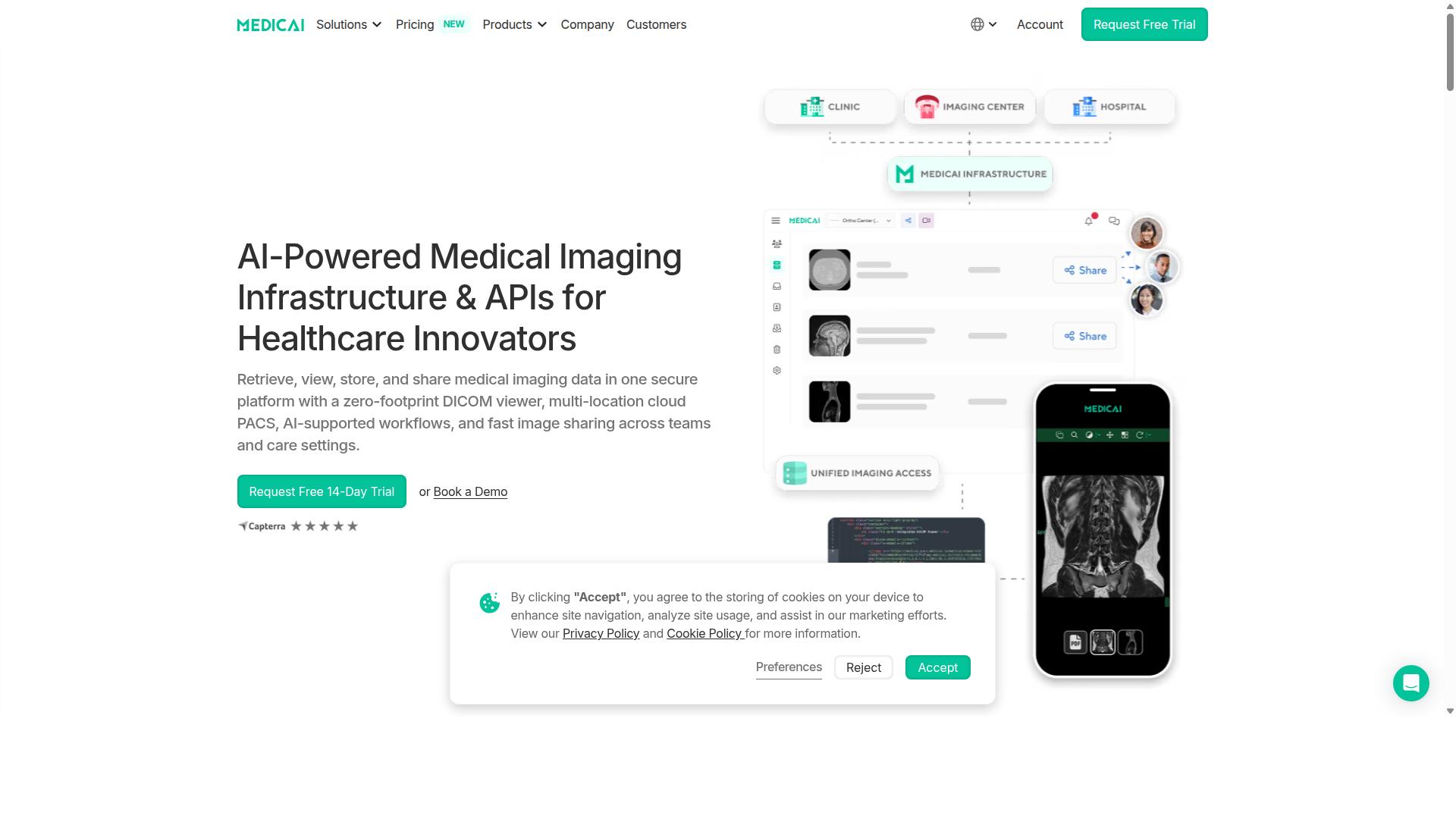
Medicai operates as a cloud-based medical imaging platform that retrieves, stores, and shares imaging data through a single secure interface. The solution combines a zero-footprint DICOM viewer with retrieval, viewing, storage, and sharing capabilities in one interface.
Healthcare teams access studies from multiple locations without installing software. The platform functions as a multi-location cloud PACS that replaces legacy on-premise systems and reduces infrastructure costs for radiology groups and hospitals.
Medicai currently stores 1.7M+ studies and maintains partnerships with Microsoft Azure and Amazon AWS. These connections support fast image delivery and reliable uptime for diagnostic imaging workflows.
The platform also provides AI-supported workflows that accelerate routine tasks such as image routing and report generation. This combination of speed and security positions Medicai as a strong option for organizations comparing image sharing solutions like Tricefy.
What Is Tricefy?
Tricefy is an ultrasound image-sharing platform that enables clinicians to send studies directly to patients and referring physicians. The service centers on streamlining the handoff of diagnostic images from the exam room to outside parties. Cloud delivery forms the core of this approach.
Clinics use the platform to move ultrasound studies without burning CDs or relying on external courier services. The workflow focuses on reducing the time between image capture and distribution. Patient engagement features allow recipients to view results on personal devices.
Healthcare teams often compare Tricefy against other medical image-sharing solutions when evaluating options. The decision typically involves weighing simplicity of use against broader system requirements. Integration depth and security standards represent common evaluation points.
Readers interested in broader medical imaging needs beyond ultrasound may find value in exploring additional platforms. Interoperability with existing PACS systems and DICOM compatibility often become deciding factors. The choice depends on practice size, specialty mix, and data-sharing volume.
Features Compared
This section compares how each platform handles image exchange speed, regulatory compliance, and system connectivity.
Medical imaging teams need reliable performance across multiple dimensions. Speed matters when radiologists review urgent cases. Security standards protect patient data during transfer. Integration capabilities determine whether new tools work with existing hospital systems.
Tricefy and Medicai approach these requirements differently. The following subsections examine specific capabilities for each platform based on publicly available features and pricing.
Image Sharing Speed & Reach
Medicai records 300k+ DICOM study visualizations in the past year, indicating active daily usage across multiple specialties.
This volume reflects consistent platform performance for image upload and download operations. Teams handling CT scans, MRI studies, and ultrasound images benefit from reliable access across different medical departments.
Tricefy provides image sharing capabilities for medical imaging workflows. The platform supports DICOM file transfer between healthcare providers without specific performance metrics published.
High visualization counts suggest Medicai handles concurrent users effectively. This matters for busy radiology departments where multiple physicians need simultaneous access to diagnostic imaging studies.
Security & Compliance
Medicai maintains HIPAA and GDPR compliance with FDA/CEE cleared viewer technology.
The platform follows OWASP security guidelines for application development. These standards address common vulnerabilities in web-based medical systems. Encryption protects data during transmission between users.
Tricefy implements general security measures for medical image sharing. The platform addresses basic data protection requirements without published certification details.
Access control features help healthcare organizations manage user permissions for patient imaging studies. Audit trails track who views or shares diagnostic images within the system.
Integration & Scalability
Medicai connects with existing PACS and EHR systems through vendor neutral archive capabilities and 50M+ yearly API transactions.
The Medical Image Exchange service enables DICOM study transfer between different healthcare facilities. The Vendor Neutral Archive function stores imaging data independently from specific equipment vendors.
Tricefy offers integration options for medical imaging workflows. The platform connects with hospital systems through standard approaches without published transaction volumes.
API connectivity allows developers to build custom solutions for radiology workflow automation. The 50M+ yearly API transactions demonstrate substantial system capacity for data exchange operations.
Pricing Compared
Medicai lists transparent monthly tiers: Starter at $249 for 500 GB and Standard at $749 for 2 TB.
These two plans include unlimited user accounts. The Starter tier allows zero connected locations while the Standard tier supports one connected location.
Tricefy keeps pricing details private and requires direct contact for quotes. This approach makes early budget planning harder for clinics comparing options.
Yearly billing on Medicai delivers 15 percent savings. The Starter plan drops to $209 monthly while the Standard plan drops to $639 monthly.
Enterprise customers access custom storage volumes and multiple connected locations. Per-study pricing also becomes available for organizations with variable imaging volumes.
Tricefy users report dealing with usage-based charges that fluctuate monthly. This model can create unpredictable costs during busy diagnostic periods.
DICOM Gateway setup carries a one-time fee of $1,000 per location. This covers secure connection between imaging devices and the cloud storage system.
Both platforms address HIPAA compliance and data security needs. Medicai's fixed monthly costs help radiology practices forecast expenses more accurately than usage-based alternatives.
Who Should Choose Medicai
Hospitals, imaging centers, and specialty practices handling high volumes of cross-modality imaging benefit from Medicai's unified platform.
Orthopedics and neurology departments often require rapid access to MRI and CT scan studies across multiple locations. Medicai supports these workflows through its multi-specialty design that accommodates radiology, cardiology, and oncology needs simultaneously.
Oncology centers and tumor boards manage complex cases that require seamless collaboration between different specialists. The platform serves these groups by enabling image sharing between physicians who work across different facilities and specialties.
Cardiology practices reviewing echocardiograms and vascular studies need consistent access to prior imaging for treatment planning. Medicai handles these requirements through its support for multiple imaging modalities within a single system.
Virtual care providers and teleradiology services benefit from the platform's ability to serve distributed teams. These organizations can share diagnostic imaging with referring physicians without requiring separate systems for each location.
Clinical trials and medical education organizations use the platform to manage imaging data across multiple study sites. The system supports these specialized workflows while maintaining the security standards required for research applications.
Personal injury lawyers and patient portal users gain access to medical records through the same infrastructure that serves medical professionals. This approach reduces the need for separate solutions when patients request their imaging studies.
Who Should Choose Tricefy
Smaller ultrasound-focused clinics and private practices seeking straightforward patient image delivery may find Tricefy sufficient.
Ultrasound-centric workflows often benefit from solutions that prioritize quick image transfer and simple patient access. Practices handling high volumes of diagnostic imaging need systems that integrate well with existing ultrasound equipment.
Tricefy generally focuses on cloud storage and basic image sharing capabilities. Smaller facilities with lighter IT requirements may prefer platforms that require minimal setup and maintenance.
Private practices that mainly need patient portal functionality for image access could consider Tricefy as an initial option. The emphasis on ultrasound workflows makes this platform particularly relevant for OB/GYN and cardiology practices.
Clinics prioritizing simple file format compatibility and basic HIPAA compliance features may find adequate solutions here. However, practices requiring advanced image viewer tools or extensive interoperability with existing PACS systems might need to evaluate additional capabilities.
Research suggests that smaller facilities often start with basic image sharing solutions before expanding their requirements. As practice needs grow, considerations around vendor neutral archive functionality and broader diagnostic imaging support become increasingly important.
Final Verdict
Medicai's verified 1M+ studies processed yearly, 50M+ API transactions, and HIPAA/GDPR compliance make it the stronger enterprise-grade choice for most multi-specialty providers.
Tricefy offers solid image sharing capabilities for smaller practices focused on basic DICOM transfer. The platform handles standard medical imaging needs without the advanced scalability features that larger organizations require.
Medicai processes over one million studies each year through its established infrastructure. The system manages over fifty million API transactions annually while maintaining full HIPAA and GDPR compliance standards.
Key differentiators include Medicai's proven track record with high-volume medical imaging workflows and extensive API connectivity. These capabilities support complex radiology workflow requirements across multiple specialties.
Tricefy provides adequate functionality for straightforward image sharing scenarios. However, organizations with growing patient volumes or multi-site operations may need additional infrastructure support.
Medicai USA operates at 7901 4th St N, STE 300, St. Petersburg, FL, 33702 with phone support at +1 (832) 220 1035. Medicai Romania maintains offices at 53-55 N Filipescu, 5th Floor, Sector 2, Bucharest, 020961 reachable at +40 316 305 875.
Organizations evaluating image sharing solutions can contact sales@medicai.org to request detailed demonstrations. The team provides personalized consultations based on specific medical imaging requirements and workflow needs.