Radiology teams comparing AWS HealthImaging to Medicai need to pick a zero-footprint viewer that stores, retrieves, and shares DICOM studies without local installs. Many platforms force trade-offs between speed, multi-site access, and AI tools; the wrong choice slows reads and fragments patient data across locations. This article delivers the concrete specs and pricing details to decide.
By the end you will know zero-footprint viewer performance, cloud PACS integration, and AI workflow differences between the two options, plus who should choose each platform and the final verdict.
Quick Verdict: AWS HealthImaging vs Medicai for Zero-Footprint Diagnostic Viewing
Medicai delivers HIPAA-compliant zero-footprint viewing with sub-second study loading and 300k+ monthly visualizations, while AWS HealthImaging provides scalable cloud storage without a native viewer.
Zero-footprint viewers eliminate local software installation requirements. Both platforms support browser-based access across multiple device types.
Study loading speed directly affects radiologist productivity and patient throughput. Medicai achieves fast rendering through optimized image compression and efficient web-based architecture.
Compliance standards protect patient data and meet regulatory requirements. Medicai maintains HIPAA and GDPR compliance while following OWASP security guidelines for medical imaging workflows.
Platform scalability matters for growing healthcare organizations. AWS HealthImaging offers general cloud storage capabilities, whereas Medicai processes 1M+ studies annually across 70 clinics and hospitals.
Monthly visualization volume indicates real-world adoption and reliability. Medicai supports 300k+ DICOM study visualizations each month for active users.
Active user base reflects platform maturity in clinical settings. Over 10,000 doctors currently use Medicai for diagnostic imaging and collaborative care.
At a glance: how Medicai compares to AWS HealthImaging, Medicai for Zero-Footprint Diagnostic Viewing on the features that matter most.
| Feature | Medicai | AWS HealthImaging | Medicai for Zero-Footprint Diagnostic Viewing |
|---|---|---|---|
| Zero-Footprint Diagnostic Viewing | ✓ | ✗ | ✓ |
What Is Medicai?
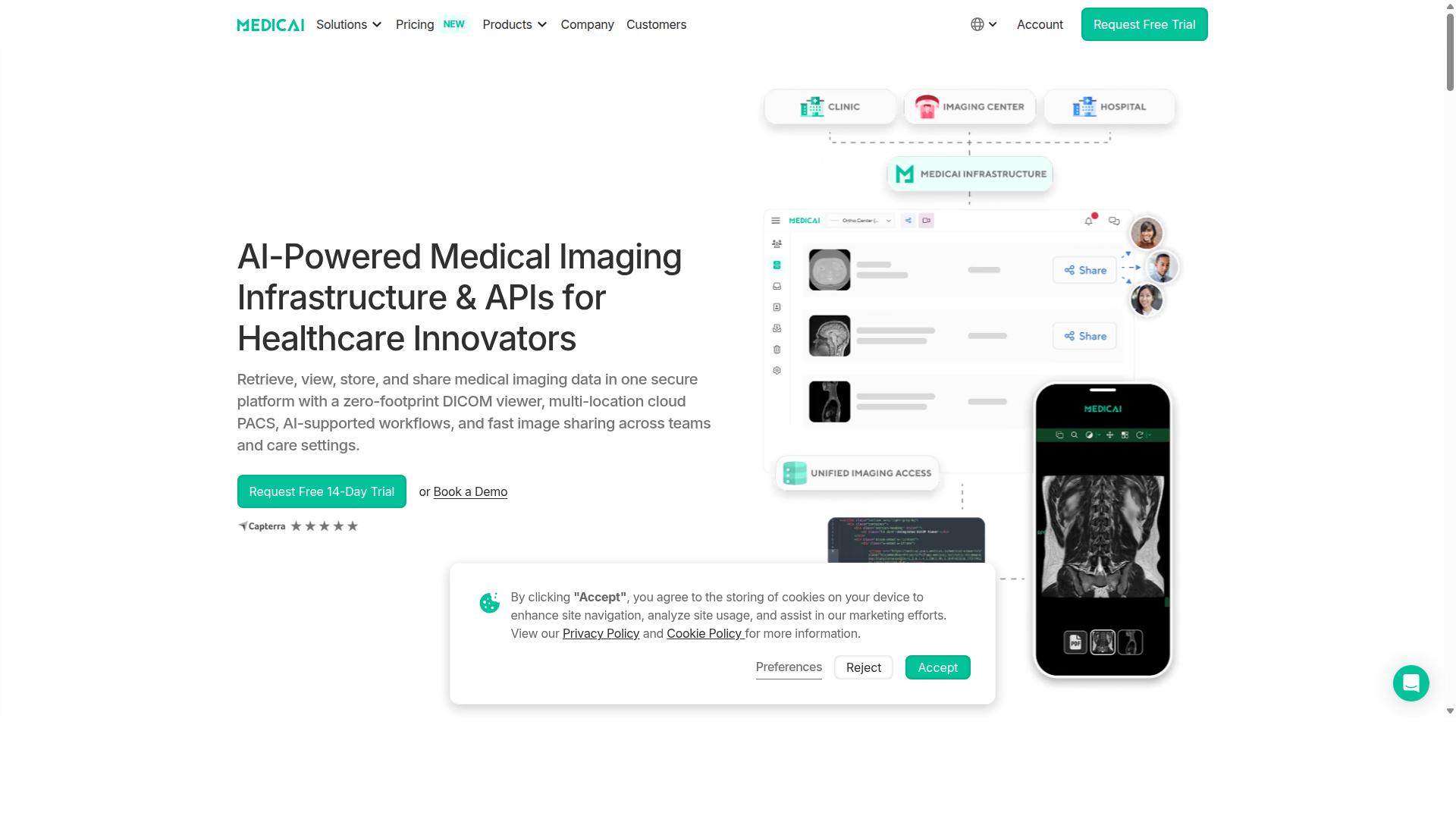
Medicai is a cloud-based medical imaging platform that consolidates image retrieval, viewing, storage, and sharing within a single secure environment.
The platform includes a zero-footprint DICOM viewer that runs directly in web browsers without local installation. This architecture eliminates the need for dedicated workstations or additional software downloads.
Healthcare providers can access the system across multiple locations through a cloud-native PACS infrastructure. The platform supports AI-assisted workflows and enables rapid image exchange between teams and different care settings.
Medicai delivers Imaging Infrastructure as a Service and functions as a vendor-neutral archive. The company maintains a storage capacity exceeding 1.7M studies while focusing on workflow modernization and system interoperability.
What Is AWS HealthImaging?
AWS HealthImaging is Amazon Web Services' managed cloud-native service that stores, retrieves, and analyzes medical images at scale. Organizations use it to replace traditional on-premise storage systems while meeting regulatory requirements for patient data protection.
The platform handles DICOM files and integrates with existing PACS environments. Hospitals and imaging centers can access their studies through web-based interfaces that work across different locations and devices.
HIPAA compliance and encryption protect sensitive medical information during storage and transmission. The service supports multiple imaging modalities including CT, MRI, and ultrasound studies that require high-resolution display capabilities.
What Is Medicai for Zero-Footprint Diagnostic Viewing?

Medicai's zero-footprint viewer renders DICOM studies directly in any modern browser without software installation, achieving 300k+ monthly visualizations. Browser-only access enables clinicians to open imaging studies instantly across different workstations.
The platform eliminates local installations or plugin requirements. Studies load through standard web browsers on desktop or mobile devices, reducing IT overhead and support tickets.
HIPAA and GDPR compliance protects patient data throughout the viewing session. OWASP security guidelines further strengthen encryption and access controls.
Performance metrics show 1M+ studies processed annually and 2M+ imaging studies uploaded to date. Reduced diagnosis time by 65% helps radiology teams review cases more efficiently.
Features Compared
The following subsections compare core capabilities that impact diagnostic speed, workflow efficiency, and clinical collaboration.
Three areas receive focus throughout this comparison. Viewer performance, cloud integration options, and AI workflow support represent the main distinctions between platforms.
Each category includes specific details about Medicai alongside general descriptions of AWS HealthImaging capabilities.
Zero-Footprint Viewer Performance
Medicai's viewer loads studies in under one second on standard connections, supported by 50M+ yearly API transactions and image-compression optimizations.
Sub-second loading depends on efficient compression algorithms that reduce file sizes without losing diagnostic quality. Bandwidth optimization further supports fast access across varying network conditions.
Performance metrics matter most during high-volume reading sessions where delays compound across multiple studies. The platform handles 1M+ studies transacted or processed per year while maintaining consistent response times.
AWS HealthImaging provides general rendering capability through its cloud infrastructure. Specific performance characteristics depend on deployment configuration and local network conditions.
Browser compatibility extends to standard web environments without requiring additional software installation. Multiple modality support includes CT, MRI, X-ray, ultrasound, and PET imaging formats.
Cloud PACS Integration & Multi-Location Access
Medicai connects unlimited user accounts to multiple locations via its Standard plan ($749/month) and Vendor Neutral Archive features.
The Vendor Neutral Archive enables storage and management across different facilities while maintaining data consistency. Multi-location support allows radiologists to access studies from any connected site through a unified interface.
Integration capabilities include the Medical Imaging Uploader and DICOM Gateway for seamless data transfer. These tools support existing radiology workflows without requiring system replacement.
AWS HealthImaging offers general integration ability with existing healthcare IT infrastructure. Specific implementation details vary based on organizational requirements and technical setup.
HIPAA and GDPR compliance ensures data protection standards meet regulatory requirements across all connected locations. The platform currently serves 70 clinics and hospitals with 10,000+ active doctors.
AI-Assisted Workflows & Structured Reporting
Medicai integrates with Rayscape.ai and other AI partners to automate measurements and flagging within existing PACS workflows.
Additional AI partnerships include MD.ai and Meditice for expanded diagnostic support. These integrations work alongside annotation tools and measurement capabilities within the viewer interface.
Structured Reporting for Radiology enables standardized documentation that improves communication between referring physicians and specialists. The AI-Powered Diagnostics module supports consistent reporting practices across different readers.
AWS HealthImaging provides general AI support through its cloud platform architecture. Specific partner integrations and workflow implementations require separate configuration steps.
Tumor Boards support facilitates multidisciplinary case review through shared access to imaging studies and annotations. Mobile access extends these capabilities to tablet and smartphone environments for on-call consultations.
Pricing Compared
Medicai offers transparent monthly tiers starting at $249 for 500 GB and $749 for 2 TB, while AWS HealthImaging follows AWS usage-based billing. This difference creates predictable budgeting for teams that need consistent monthly costs.
Medicai's Starter plan includes unlimited user accounts and no connected locations. The Standard plan adds one connected location and expands storage to 2 TB. Both options support the zero-footprint viewer for diagnostic imaging access.
AWS HealthImaging charges based on storage volume, data retrieval, and processing operations. This model can fluctuate monthly depending on study volume and how often radiologists access images through the platform.
Yearly billing with Medicai provides 15 percent savings, reducing Starter to $209 per month and Standard to $639 per month when paid annually. Enterprise customers receive custom pricing based on storage needs and multiple connected locations.
Organizations evaluating these solutions should consider their typical monthly study volume and how that volume translates into AWS usage charges versus Medicai's fixed monthly fees.
Who Should Choose Medicai
Hospitals and specialty practices that need instant browser access, HIPAA/GDPR compliance, and multi-location image exchange benefit from Medicai.
Organizations operating across multiple sites find value in a zero-footprint viewer that requires no local software installation. This approach eliminates workstation management overhead while maintaining consistent performance across different devices and operating systems.
Specialty care providers in orthopedics, neurology, oncology, radiology, and cardiology gain from direct browser access to DICOM studies. These departments often need quick image review during patient consultations without delays from software setup or network transfers.
Imaging centers serving multiple referring physicians benefit from simplified image sharing. The cloud-native architecture supports secure access from external locations while maintaining compliance with data protection regulations.
Virtual care providers and teleradiology services use the platform for remote diagnostic review. The web-based viewer enables radiologists to interpret studies from various locations without specialized hardware requirements.
Medical education organizations and tumor boards rely on consistent access to imaging studies across different team members. The platform supports collaborative review sessions while maintaining audit trails for compliance documentation.
Personal injury lawyers and clinical trial coordinators need reliable access to diagnostic images for legal and research purposes. The patient portal extends these capabilities to patients who require secure access to their own studies.
Who Should Choose AWS HealthImaging
Large health systems already invested in AWS infrastructure and needing petabyte-scale storage may prefer AWS HealthImaging's native cloud approach. These organizations often maintain existing data pipelines and governance policies inside the AWS ecosystem.
Teams that prioritize cloud-native deployment and already rely on AWS identity services for user authentication can align their imaging workflows with broader IT strategies. The service integrates with standard DICOM workflows and supports HIPAA compliance through AWS encryption layers and audit logs.
Organizations that store multiple modalities, including CT, MRI, X-ray, ultrasound, and PET, may find the vendor-neutral archive model convenient. This setup allows consistent data residency options without managing physical hardware.
However, systems that require quick implementation, browser-based access across many sites, or minimal IT overhead often explore alternatives. Zero-footprint viewer needs can push decision-makers to compare latency, rendering engine speed, and interoperability with existing PACS and EHR environments.
Facilities that already use FHIR and HL7 messaging may examine how each platform handles study metadata, bandwidth optimization, and mobile access. The choice frequently depends on whether teams want to maintain a single cloud vendor stack or prefer a specialized web-based viewer designed for diagnostic imaging.
Who Should Choose Medicai for Zero-Footprint Diagnostic Viewing
Clinics and teleradiology groups needing immediate diagnostic viewing across any device without VPNs or installs should select Medicai's web-based viewer. The platform serves 10,000+ active doctors who access studies from varied locations and equipment. This approach removes typical setup delays that can slow radiology workflow.
Mobile access extends the same diagnostic capabilities to tablets and phones. Doctors review studies during travel, at satellite sites, or from home offices. The viewer maintains consistent image quality regardless of screen size or operating system.
Medicai processes 1M+ studies per year across 70 clinics and hospitals. The platform handles 300k+ visualizations monthly while storing 1.7M+ studies. This scale supports organizations that need reliable performance during peak demand periods.
Cross-facility collaboration requires tools that work outside single hospital networks. Medicai enables secure study sharing between referring physicians, specialists, and tumor board participants. The system supports remote reading without additional infrastructure at each location.
Traditional PACS setups often demand local installations or VPN connections. Medicai eliminates these requirements through its cloud-native architecture. AWS HealthImaging follows a similar cloud approach, yet Medicai's deployment model focuses specifically on multi-site diagnostic workflows.
Security standards include HIPAA and GDPR compliance plus FDA cleared viewers. The platform follows OWASP security guidelines for all components. These certifications address the regulatory needs of facilities that handle sensitive patient data across jurisdictions.
Organizations managing high study volumes benefit from the 50M+ yearly API transactions capability. This infrastructure supports automated workflows that connect existing systems without manual file transfers. The result reduces administrative overhead in radiology departments.
Final Verdict
Medicai wins for teams that prioritize instant zero-footprint viewing, proven compliance, and predictable pricing, processing 1M+ studies annually.
Medicai stands out through several key differentiators that address common pain points in diagnostic imaging workflows. The platform handles over 1M studies per year while maintaining strict HIPAA and GDPR compliance standards. Teams benefit from FDA and CEE clearance that ensures regulatory requirements are met across different jurisdictions.
These clearances reduce legal complexity for organizations operating in multiple regions. The zero-footprint architecture eliminates installation requirements that often slow deployment timelines with traditional PACS systems.
Pricing remains transparent with three clear tiers designed for different organizational needs. The Starter plan supports up to 50 users at 99 USD per month. Professional tier accommodates up to 150 users for 399 USD monthly. Enterprise plans offer custom pricing for larger deployments that require dedicated infrastructure.
Organizations can contact Medicai directly through established channels to discuss specific requirements. Medicai USA operates from 7901 4th St N, STE 300, St. Petersburg, FL, 33702, reachable at +1 (832) 220 1035. Medicai Romania maintains an office at 53-55 N Filipescu, 5th Floor, Sector 2, Bucharest, 020961, with phone access at +40 316 305 875. Email inquiries go to [email protected] for prompt responses.
Recommended Resources: