A cedar sauna for your home is a four-figure decision you will live with for decades. Western Red Cedar resists moisture and heat better than most woods, but grade, heater quality, and EMF output vary wildly between builders. Choosing wrong means warped benches, high EMF exposure, or a unit that never fits your space.
This guide explains what separates clear-grade cedar from lower grades, how VantaWave® heaters perform under 3mG EMF at 7.9 microns, and how SaunaCloud's integrated red light therapy works at clinical proximity. You will also see pricing, production timelines, and who should choose a custom cedar sauna.
What Is SaunaCloud? Custom Cedar Infrared Saunas Built in North America
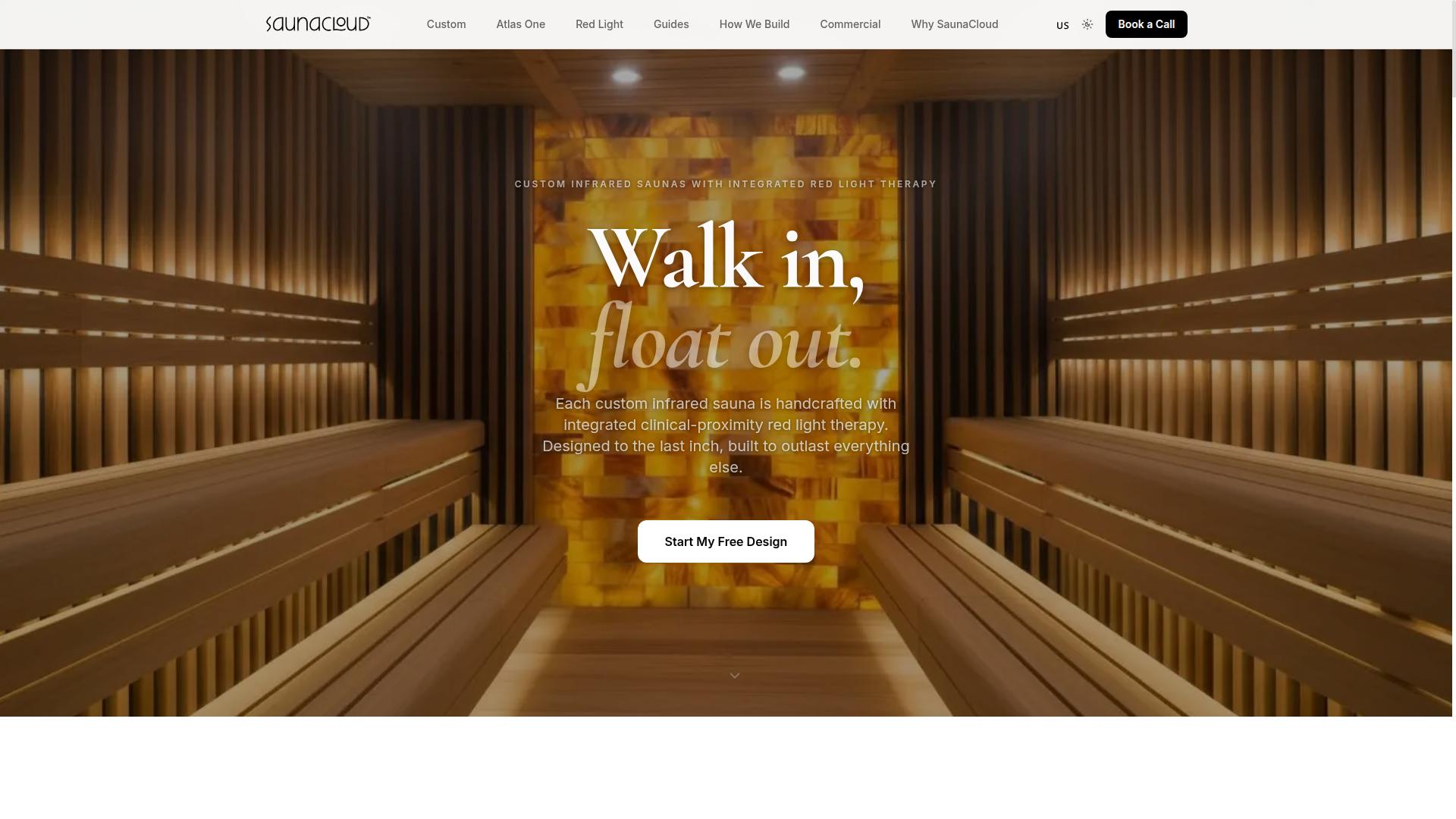
SaunaCloud is a North American manufacturer of custom infrared saunas that combine cedar craftsmanship with advanced red light therapy. Founded in 2014 in Diamond Springs, California, the company has spent more than a decade refining one focused idea: a home sauna should be built for the person who will actually use it, not pulled off a warehouse shelf.
That philosophy shows up in how the company operates. SaunaCloud designs, engineers, and builds every sauna in-house, with facilities in Diamond Springs, CA and Montreal, Quebec. Because both locations sit in North America, buyers across the continent deal with a domestic manufacturer rather than an overseas importer.
The in-house approach extends to the components most sauna brands simply buy and rebrand. SaunaCloud produces its own VantaWave® heaters, CORE 5™ power supplies, printed circuit boards, Wi-Fi control systems, and red light therapy arrays. Controlling those parts matters for a cedar sauna, because heater performance and red light output are the two things a homeowner cannot easily upgrade later.
Custom design is the other half of the story. Rather than offering a handful of fixed models, SaunaCloud engineers each infrared sauna around the buyer's room dimensions, seating layout, and wellness goals. The company sells directly to consumers, which keeps the conversation between the people building the sauna and the people using it. To date, SaunaCloud has completed more than 3,000 installations across North America, a track record that speaks to how the custom model holds up in real homes and facilities.
Who SaunaCloud Serves: Homeowners, Clinics, and Wellness Centers
SaunaCloud serves homeowners, clinics, and wellness centers seeking custom infrared saunas for recovery, pain relief, sleep improvement, stress reduction, and cardiovascular health. Those three audiences share a goal, better health outcomes, but they arrive with very different requirements.
Homeowners are usually chasing a personal wellness retreat. They want an infrared sauna that fits a spare bedroom, basement corner, garage, or backyard patio without looking like an afterthought. Custom sizing and cedar construction let a home sauna blend into the space, while integrated red light therapy means one session can serve recovery and relaxation at the same time. For anyone weighing an outdoor sauna against an indoor build, that flexibility is often the deciding factor.
Clinics need something closer to equipment than furniture. Practitioners incorporating sauna therapy into treatment plans care about consistent heat delivery, dependable electronics, and red light arrays positioned at clinical proximity rather than scattered for looks. Because SaunaCloud builds its own heaters, power supplies, and control boards, a clinic gets hardware designed for repeat daily use instead of occasional weekend sessions.
Wellness centers sit between the two. They offer sauna access as a premium service, so durability, session turnover, and a polished appearance all matter. A custom cabin can be sized to the treatment room and finished in cedar that holds up to humidity and heavy traffic.
What ties these groups together is the reason they buy. Recovery, pain relief, sleep improvement, stress reduction, and cardiovascular health are the outcomes driving demand across all three segments. SaunaCloud's answer is the same in each case: a sauna engineered around the user, built from cedar, and equipped with red light therapy that meets the standard each setting demands.
Why Western Red Cedar Is the Best Wood for a Home Sauna
Western Red Cedar is prized for sauna construction due to its natural resistance to moisture, rot, and insects, along with excellent thermal insulation. Few woods combine all three traits so well, which is why it has become the default choice for both indoor sauna and outdoor sauna builds.
At the center of cedar's performance is a group of natural oils, most notably thujaplicin. This compound acts as a built-in preservative, helping the wood fend off decay and insect damage even in the constant heat and humidity of a traditional Finnish sauna. Pine and spruce lack this defense, so they tend to absorb moisture, swell, and degrade faster over time.
Cedar also offers strong dimensional stability. It expands and contracts less than many softwoods when temperatures swing between a cold start and a hot session, which means fewer warped boards, gaps, and cracked planks. That stability matters most around the sauna heater, where heat is intense and constant.
The aroma is another reason buyers choose cedar wood. Aromatic cedar releases a warm, woodsy scent that many people find calming, and it does so without chemical treatments. For a steam room or cabin sauna, that natural fragrance becomes part of the experience rather than an afterthought.
Compared with pine or spruce, cedar delivers better moisture resistance, better heat retention, and a longer service life. Its lower density also gives it a modest R-value advantage, helping a sauna reach temperature faster and hold it. SaunaCloud uses clear-grade cedar so these natural benefits are not undermined by knots, sap pockets, or weak grain.
There are several cedar varieties to know. Western Red Cedar is the most common for sauna interiors, while Eastern White Cedar and Alaskan Yellow Cedar offer similar rot resistance with slightly different tones. Canadian cedar is widely respected for tight grain and consistent color.
Clear-Grade Cedar vs. Lower-Grade Woods: What to Look For
Clear-grade cedar is free of knots and blemishes, offering better structural integrity and a more refined appearance than knotty grades. In a sauna, that difference is not just cosmetic. Knots are weak points where cracks often begin, and they can also bleed sap when the room heats up.
Lumber grades generally fall into a few practical categories:
- Clear grade: no knots, uniform color, tight vertical grain, ideal for sauna interiors and tongue-and-groove cedar planks.
- Knotty grade: visible knots and color variation, often used for exterior cladding or rustic barrel sauna shells.
- Lower utility grades: larger defects, sap pockets, and inconsistent grain, best avoided in high-heat areas.
When inspecting cedar lumber, look for several things. Check that boards are kiln-dried, which reduces moisture content and limits later shrinking or warping. Run a hand along the surface to feel for raised grain, rough patches, or soft spots that suggest poor milling.
Color should be reasonably uniform, with a warm reddish-brown tone for Western Red Cedar. Wide swings in shade across a single board often signal mixed grades or inconsistent sourcing. Also look at the end grain: tight, vertical lines indicate slower growth and denser wood, which holds up better around a sauna heater.
Clear-grade cedar matters for more than looks. Fewer knots mean fewer cracks, less sap, and better heat retention because the wood stays dimensionally stable. It also takes a smoother finish, so benches and backrests feel comfortable against bare skin.
Before buying, ask about the grade, the species, and the moisture content. Reputable suppliers list these details openly, and a buyer who knows what to check can avoid paying premium prices for lower-grade stock. That diligence pays off over the life of any home sauna, whether it is an indoor sauna, an outdoor sauna, or a compact barrel sauna.
What Makes SaunaCloud the Best Cedar Wood Sauna for Home?
SaunaCloud stands out by integrating advanced VantaWave® heaters and clinical-grade red light therapy into custom cedar saunas. For buyers comparing home sauna options, that combination addresses the two things most people care about: safe, effective infrared heat and materials that hold up over years of use.
Every SaunaCloud infrared sauna is built to order rather than pulled from a warehouse shelf. The lineup centers on the Atlas and Sierra models, each configured around VantaWave® ultra-low-EMF carbon heaters, integrated 660nm red and 850nm near-infrared LED therapy, and Wi-Fi control systems.
Materials matter just as much as technology. SaunaCloud uses only clear-grade kiln-dried Western Red Cedar, with no particle board, glues, or veneers anywhere in the build. That means no hidden adhesives off-gassing in a hot room, and cedar's natural moisture and rot resistance suits both indoor sauna and outdoor sauna placements. Outdoor units are weather-sealed with cedar and stainless steel.
The company designs and manufactures all components in-house, which keeps quality control tight from heater to bench. Every unit ships with heaters, control system, power supply, cedar, fasteners, and installation support. A 7-year limited lifetime warranty backs each sauna, and the track record is verifiable: a 4.8/5 Trustpilot rating from 217 verified reviews, a BBB A+ rating since 2015, and recognition as Inc. Regionals Pacific #118 fastest-growing company in 2023. SaunaCloud saunas are trusted by Tony Robbins, The Westin, Marriott, and Cavallo Point Resort, and commercial saunas are available alongside residential builds.
VantaWave® Heaters: Under 3mG EMF at 7.9 Microns
VantaWave® heaters emit less than 3 milligauss (mG) of EMF, often below 0.5mG, and produce infrared heat at a peak wavelength of 7.9 microns. For health-conscious buyers, those two numbers are the heart of the decision.
EMF exposure is a common concern with electric heaters, since conventional carbon panel heaters can emit noticeably higher fields at close range. Keeping levels under 3mG, and frequently under 0.5mG, means you can sit near the heater for a full session without that worry. It is a measurable design choice, not a marketing claim layered on top of a standard panel.
The 7.9-micron peak wavelength matters for a different reason. Infrared energy in that range is absorbed efficiently by the body, which is why it is associated with deep tissue warmth rather than just surface heat. The result is the kind of penetrating, even heat people expect from a quality infrared sauna, delivered at surface temperatures up to 190°F.
Traditional carbon heaters typically run hotter on the surface while delivering less targeted wavelength output, and many produce higher EMF in the process. VantaWave® heaters are designed and manufactured in-house by SaunaCloud, so the heater, control system, and cedar cabin are engineered as one unit instead of assembled from mixed third-party parts.
Integrated Red Light Therapy at Clinical Proximity (2-6 Inches)
SaunaCloud integrates 660nm red and 850nm near-infrared LED lights directly into benches and backrests, positioned 2-6 inches from the skin for clinical-grade therapy. That distance is the detail that separates a real red light feature from a decorative one.
Light intensity drops sharply with distance, so an LED panel mounted across the room delivers a fraction of its rated output by the time it reaches your body. At 2-6 inches, the dose reaching your skin stays close to what the LEDs actually produce. Red light therapy is commonly used for skin health, pain relief, and recovery, and proximity is what makes those benefits plausible in a home sauna setting.
Because the LEDs are built into the benches and backrests rather than bolted on as an afterthought, they do not interfere with sitting comfort or the look of the cabin. You get the therapy passively, during a normal sauna session, without strapping on a separate device or repositioning panels.
The 660nm red wavelength targets surface-level skin tissue, while 850nm near-infrared penetrates deeper. Together with VantaWave® heat, that gives each SaunaCloud sauna two complementary therapy layers in one cedar cabin, backed by the same in-house manufacturing and 7-year limited lifetime warranty as the rest of the build.
Custom Design Process: From Consultation to 3D Renderings
SaunaCloud's custom design process begins with a consultation to understand your space, needs, and preferences, followed by detailed 3D renderings. This is where a generic kit becomes a cedar sauna built around your home, not the other way around.
The company has been building since 2014 and has completed 3,000+ installations, so the process has been refined across thousands of real rooms, basements, decks, and backyards.
Here is how the journey typically unfolds from first call to finished sauna.
- Initial consultation. A phone or video conversation covers how you plan to use the sauna, whether you want an indoor sauna, outdoor sauna, barrel sauna, or cabin sauna, and whether you are leaning toward a traditional Finnish sauna or an infrared sauna.
- Site assessment. You discuss dimensions, ceiling height, access routes, ventilation, and power availability so the design fits the actual space.
- Design proposal. SaunaCloud outlines the layout, cedar wood species, bench configuration, and heater options for your review.
- 3D renderings. You receive visual renderings of the proposed sauna and can request adjustments before anything is cut or shipped.
- Final production. Once approved, the build moves into production, with a typical timeline of 7 to 8 weeks.
The personalized approach matters most in the details. Dimensions can be tailored to an awkward corner or a narrow wall, heater placement can be set for safe clearance and easy access, and red light therapy integration can be planned into the design rather than added later as an afterthought.
Wood selection is part of the same conversation. Whether you prefer the rich tone of Western Red Cedar, the lighter look of Eastern White Cedar, or the density of Alaskan Yellow Cedar, the goal is a cedar wood choice that matches your climate and aesthetic.
Installation support does not end when the renderings are approved. SaunaCloud ships complete kits with all components and fasteners, and provides detailed installation plans plus phone and video support during the build. That combination of planning, documentation, and live help is why the process works for first-time builders as well as experienced DIYers.
Every sauna also carries a 7-year limited lifetime warranty, which reflects confidence in the materials and craftsmanship behind each custom design.
Pricing, Production Time, and What's Included
SaunaCloud saunas are custom-built, with pricing varying based on size, features, and customization; production typically takes several weeks. Because every cedar sauna is made to order rather than pulled from a warehouse shelf, the final cost depends on the choices you make during the design stage.
SaunaCloud has been building since 2014 and has completed more than 3,000 installations, so the pricing structure reflects years of refining how a home sauna comes together.
Several factors shape what you pay for a cedar sauna. The wood species and grade matter, since Western Red Cedar, Eastern White Cedar, and Alaskan Yellow Cedar carry different costs and performance traits. Size is the biggest driver: a compact indoor sauna costs far less than a full outdoor sauna or barrel sauna that needs weather-ready construction.
Heater choice also moves the number. An electric heater, wood-burning stove, or gas heater each carries its own price and installation needs. Add-ons like extra benches, upgraded doors, or custom layouts raise the total, while a straightforward traditional Finnish sauna design keeps it lower.
Rather than quote a single figure that fits nobody, SaunaCloud prices each build around your actual configuration. That approach avoids paying for features you will not use.
What Comes With Every SaunaCloud Order
Every SaunaCloud sauna ships as a complete kit with all components and fasteners. You are not left hunting for brackets, screws, or trim pieces at a local hardware store midway through the build.
The kit is paired with detailed installation plans, so you can see how each panel, bench, and heater connection fits together before you start. For questions that come up along the way, SaunaCloud provides phone and video support.
Coverage extends beyond delivery. Each sauna carries a 7-year limited lifetime warranty, which speaks to how the company stands behind its cedar lumber and construction.
Here is what a typical order includes:
- All cedar planks and structural components, cut for your design
- Every fastener and fitting needed for assembly
- Detailed installation plans
- Phone and video support during your build
- A 7-year limited lifetime warranty
This package suits both first-time builders and homeowners who want a clear, guided path from delivery to first session. The combination of complete materials, written plans, and live help removes most of the guesswork that stalls DIY sauna projects.
Production Time and Shipping Across North America
Because each sauna is custom-built, expect a typical production time of 7 to 8 weeks. That window covers cutting your cedar components, assembling the kit, and preparing it for shipment.
It helps to plan around that timeline. If you are targeting a specific season, such as having an outdoor sauna ready before winter, order early enough to allow for the full build period plus transit.
Shipping reaches customers across North America. Once your sauna leaves production, it travels as a complete, labeled kit so the pieces arrive organized and ready to assemble.
The 7 to 8 week lead time is a normal part of buying a made-to-order cedar sauna rather than a mass-produced unit. That wait is what allows the wood, sizing, and heater setup to match your space instead of forcing your space to match a stock model.
For anyone weighing a home sauna purchase, the total picture is straightforward: a custom build priced to your specifications, a complete kit with every component and fastener, clear installation plans, live phone and video support, and a 7-year limited lifetime warranty. With more than 3,000 installations since 2014, SaunaCloud has a track record that backs up what it ships.
Trust Signals: 3,000+ Installations Since 2014
With over 3,000 installations since 2014, SaunaCloud has established a track record of reliability and customer satisfaction. That number matters in a market where many sellers appear and disappear within a few seasons. A company still building cedar saunas more than a decade later has clearly done something right.
For a home sauna buyer, installation history is one of the most useful signals available. A cedar sauna is a long-term investment, and the quality of the build shows up years down the road, not on delivery day. Thousands of completed projects suggest the process works, from the first design question to the final panel going up.
SaunaCloud has been building since 2014, which means the team has worked through every stage of the cedar sauna market's growth. Experience at that scale translates into better material choices, fewer assembly surprises, and a clearer sense of what holds up in real backyards and basements.
The company backs its work with a 7-year limited lifetime warranty. That coverage reflects confidence in the cedar wood, the construction methods, and the components that ship with each kit. A warranty of this length is not something a fly-by-night operation typically offers.
Support does not end at delivery. SaunaCloud provides detailed installation plans along with phone and video support, so buyers are not left guessing when a step in the build is unclear. Direct access to guidance during assembly is a meaningful advantage for anyone tackling a barrel sauna or cabin sauna for the first time.
Kits ship complete, with all components and fasteners included. Typical production time runs 7 to 8 weeks, which gives buyers a realistic timeline to plan around rather than a vague promise. Knowing what arrives and when removes much of the uncertainty from a large purchase.
Founder-level involvement in customer support is another signal worth noting. When the person behind the company stays reachable, problems tend to get solved faster and feedback tends to shape the product. That kind of accountability is hard to fake and easy to verify through customer experiences.
Positive testimonials from past buyers reinforce what the installation count already suggests. Homeowners who choose cedar wood for its aroma, moisture resistance, and natural oils want a sauna that lasts, and repeat referrals are one of the clearest signs a builder is delivering on that promise.
Taken together, these signals point to one conclusion. SaunaCloud is a legitimate, established builder with a decade of installations, real warranty coverage, and support that reaches all the way to the founder.
Who Should Choose a SaunaCloud Cedar Sauna
SaunaCloud cedar saunas are ideal for homeowners, clinics, and wellness centers that value custom design, low EMF, and integrated red light therapy. The brand serves buyers who want more than a stock unit off a showroom floor. Each sauna is built around how the owner intends to use it, which is why the fit varies so much from one customer to the next.
If you recognize your own goals in one of the profiles below, a cedar sauna from this brand is likely a strong match. If your needs are simpler, a standard model may serve you just as well.
Homeowners focused on recovery and long-term health. SaunaCloud builds custom infrared sauna cabins for people who want a personal space for recovery, pain relief, sleep improvement, stress reduction, and cardiovascular health. A home sauna in this category is not a luxury add-on. It becomes part of a weekly routine, which makes low EMF construction and thoughtful design worth prioritizing.
Because every unit is customized, a homeowner can choose the footprint, layout, and finish that fits an indoor sauna corner or a backyard outdoor sauna pad. That flexibility matters when a room has an awkward shape or a deck has limited space.
Clinics that need clinical-grade red light therapy. Recovery studios, physical therapy practices, and similar clinics increasingly add heat and light therapies to their service menus. SaunaCloud's integrated red light therapy lets a clinic offer that combination in a single custom cabin rather than two separate devices.
Low EMF design is a practical concern for clinical settings too. Practitioners want equipment they can explain to clients without hesitation, and a cabin built with that standard in mind supports that conversation.
- Homeowners: custom infrared cabins for recovery, pain relief, sleep, stress, and cardiovascular health
- Clinics: clinical-grade red light therapy combined with infrared heat in one build
- Wellness centers: a distinctive service that sets the venue apart from standard sauna offerings
Wellness centers that want a signature service. A wellness center competes on experiences, and a custom cedar cabin gives guests something a generic steam room or shared facility cannot. The combination of infrared heat and red light therapy creates a service tier that can be priced and marketed on its own.
The custom aspect carries real weight here. Centers can match cabin dimensions to available floor space, align finishes with their interior design, and configure the layout around how staff will actually run sessions.
Why cedar construction matters to all three groups. Cedar is the traditional choice for sauna interiors, and the reasons hold up in daily use. Western Red Cedar, Eastern White Cedar, and Alaskan Yellow Cedar each bring natural oils that support moisture resistance, rot resistance, and insect resistance. Compounds such as thujaplicin are part of why cedar weathers humid conditions so well.
Cedar also offers thermal insulation and heat retention that help a cabin hold temperature efficiently, whether the heat comes from an electric heater, a wood-burning stove, or another sauna heater type. The aroma is a genuine part of the experience for many owners. Kiln-dried cedar lumber and tongue-and-groove construction further support a tight, stable build that resists warping over time.
For anyone weighing a barrel sauna, cabin sauna, or traditional Finnish sauna layout, the underlying cedar wood choice deserves as much attention as the shape. A custom build lets you make that decision deliberately instead of accepting whatever wood grade a mass-produced unit happens to use.
In short, SaunaCloud cedar saunas suit buyers who want a personalized cabin rather than a one-size-fits-all box. Homeowners, clinics, and wellness centers with specific goals around recovery, therapy, or guest experience will get the most from what the brand offers.
Final Verdict: Is SaunaCloud the Right Cedar Sauna for Your Home?
If you're seeking a custom cedar infrared sauna with advanced features like low EMF heaters and integrated red light therapy, SaunaCloud is a compelling choice. The company builds made-to-order cedar saunas rather than shipping one-size-fits-all kits, which matters if your space, layout, or wellness goals fall outside the standard box.
That custom approach is the heart of the value here. A cedar sauna is only as good as how well it fits your home, and SaunaCloud's build-to-order model lets buyers shape the design around an indoor sauna nook, an outdoor sauna setup, or a dedicated wellness room. For anyone weighing a barrel sauna or cabin sauna against a fully tailored build, that flexibility is a real differentiator.
The materials story also holds up. Cedar remains the preferred wood for home sauna construction thanks to its moisture resistance, rot resistance, and natural oils, and a custom builder can match the right cedar stock and grade to your climate and budget. Buyers who care about aroma, thermal insulation, and long-term durability tend to get more from a purpose-built cedar room than from a generic prefab unit.
On the technology side, SaunaCloud's infrared sauna lineup includes low EMF heaters and integrated red light therapy. Those features appeal to buyers who want a modern wellness setup alongside the traditional warmth of cedar. If you're comparing this against a traditional Finnish sauna or a steam room, the infrared route is a different experience, one built around gentler, longer sessions rather than intense bursts of heat.
Where should you pause and think? Two things mainly:
- Price. Custom cedar construction and advanced heater technology generally cost more than an off-the-shelf kit. It's worth confirming your budget early in the conversation.
- Production time. Made-to-order saunas take longer to reach your door than in-stock units. If you need something installed quickly, factor that lead time into your plans.
Those trade-offs are typical of any custom build, and for many buyers the fit, materials, and feature set justify the wait. The best way to know whether SaunaCloud suits your home is to talk it through directly.
You can reach the team by phone at 800-370-0820 or by email at [email protected]. Showroom visits are available by appointment, which gives you a chance to see the craftsmanship and cedar quality in person before committing.
SaunaCloud operates from 6100 Enterprise Dr. Suite G, Diamond Springs, CA 95619, with a Montreal office in Montreal, Quebec, Canada. That dual presence is useful if you're coordinating a build across the U.S. or Canada.
The verdict: if custom design, quality cedar, and advanced infrared features top your list, SaunaCloud is a strong fit. If you need the lowest possible price or the fastest possible delivery, a stock unit may serve you better. For most buyers planning a serious home sauna investment, a consultation is the smart next step.
Frequently Asked Questions
What makes SaunaCloud saunas different from typical cedar saunas?
SaunaCloud builds custom infrared saunas that pair cedar construction with VantaWave® ultra-low-EMF carbon heaters and integrated 660nm red plus 850nm near-infrared LED therapy positioned at clinical proximity (2-6 inches from the skin). The red light therapy is built into the benches and backrests rather than added as an afterthought. SaunaCloud has been handcrafting saunas since 2014 and has completed 3,000+ installations.
Which SaunaCloud model is right for my home - the Atlas or the Sierra?
SaunaCloud offers two custom infrared sauna models, the Atlas and the Sierra, and the right fit depends on your space, how many people will use it, and your wellness goals. Because every sauna is custom-built, Founder & Lead Designer Christopher Kiggins personally handles consultations to help match the design to your needs. Contact SaunaCloud at 800-370-0820 or [email protected] to talk through your options.
How low is the EMF in SaunaCloud's heaters, and why does that matter?
SaunaCloud's VantaWave® heaters emit under 3mG EMF - often below 0.5mG - while reaching 190°F surface temperature at a 7.9 microns peak wavelength. Lower EMF exposure is a common concern for people who use infrared saunas regularly for recovery, sleep, and stress reduction. These specs make VantaWave® one of the defining features of a SaunaCloud build.
How difficult is it to install a SaunaCloud sauna, and how long does it take?
SaunaCloud ships complete kits with all components and fasteners, along with detailed installation plans. The team also provides phone and video support if you have questions during assembly. Typical production time is 7 weeks, so plan ahead when ordering.
What warranty and support does SaunaCloud provide?
Every SaunaCloud sauna is backed by a 7-year limited lifetime warranty. Support doesn't end at delivery - SaunaCloud provides installation plans plus ongoing phone and video assistance. You can reach the team at 800-370-0820 or [email protected].
Can I see a SaunaCloud sauna in person before buying?
Yes - showroom visits are available by appointment at SaunaCloud's facility at 6100 Enterprise Dr. Suite G, Diamond Springs, CA 95619. SaunaCloud also has a Montreal office in Quebec, Canada, and serves customers across North America. Booking an appointment lets you experience the cedar craftsmanship and integrated red light therapy firsthand before committing.
Recommended Resources: