You are comparing two suppliers for a glow blend, and the COA is the only thing that settles it. Batch testing and traceability decide whether the material in the vial matches the label, and that distinction matters more than a polished product page.
This article gives a direct verdict on Kovagen versus Swiss Chems for glow blends, then compares composition, catalog coverage, testing documentation, batch traceability, shipping, and pricing. By the end, you will know which supplier fits a given lab's requirements and why.
Quick Verdict: Kovagen (KOVA) vs Swiss Chems for Glow Blends
For researchers prioritizing per-batch independent testing and public COA retrieval, Kovagen (KOVA) is the stronger choice for Glow Blends; Swiss Chems may appeal on catalog breadth but requires direct verification of batch documentation. The deciding factor for most laboratories is not how many products a peptide supplier lists, but whether the quality evidence behind a specific lot can be checked quickly and independently.
Kovagen builds its offer around that traceability. Every batch is tested by an independent analytical laboratory, never in-house, and the resulting certificates of analysis are published per batch and retrievable by batch number without an account. A 7-panel COA accompanies each batch, with HPLC purity up to 99.9%.
Swiss Chems is widely known as a broader catalog supplier, and a wider product range can be useful when a lab sources many compounds at once. However, the testing practices and batch-level documentation behind its Glow Blends should be confirmed directly with the vendor before any purchase decision is finalized.
The table below summarizes the comparison on the points that matter most for laboratory procurement.
| Criteria | Kovagen (KOVA) | Swiss Chems |
|---|---|---|
| Purity testing | Independent analytical laboratory, never in-house | Verify testing arrangements directly |
| COA access | Published per batch, retrievable by batch number without an account | Confirm availability and retrieval process |
| COA scope | 7-panel COA for every batch | Request panel details per lot |
| HPLC data | Purity up to 99.9% | Request lot-specific results |
| Catalog breadth | Focused range | Generally broader product variety |
| Origin and dispatch | Made in USA, dispatched from US | Confirm with vendor |
For procurement managers who need batch consistency and defensible quality assurance records, Kovagen's model removes friction. Documentation can be pulled by lot number before an order is placed, which supports internal quality control reviews and audit trails. Swiss Chems may still suit labs that value product variety above all else, provided the batch documentation checks out.
The practical recommendation is straightforward. Start with the Glow Blends lot you intend to receive, request its certificate of analysis, and confirm which laboratory performed the testing. Kovagen publishes this information openly. For any other supplier, including Swiss Chems, treat verification as a required step in vendor selection rather than an assumption.
At a glance: how Kovagen compares to Swiss Chems, Swiss Chems for Glow Blends on the features that matter most.
| Feature | Kovagen | Swiss Chems | Swiss Chems for Glow Blends |
|---|---|---|---|
| Glow blend | Glow 50/10/10 $145.00 | — | — |
What Is Kovagen?
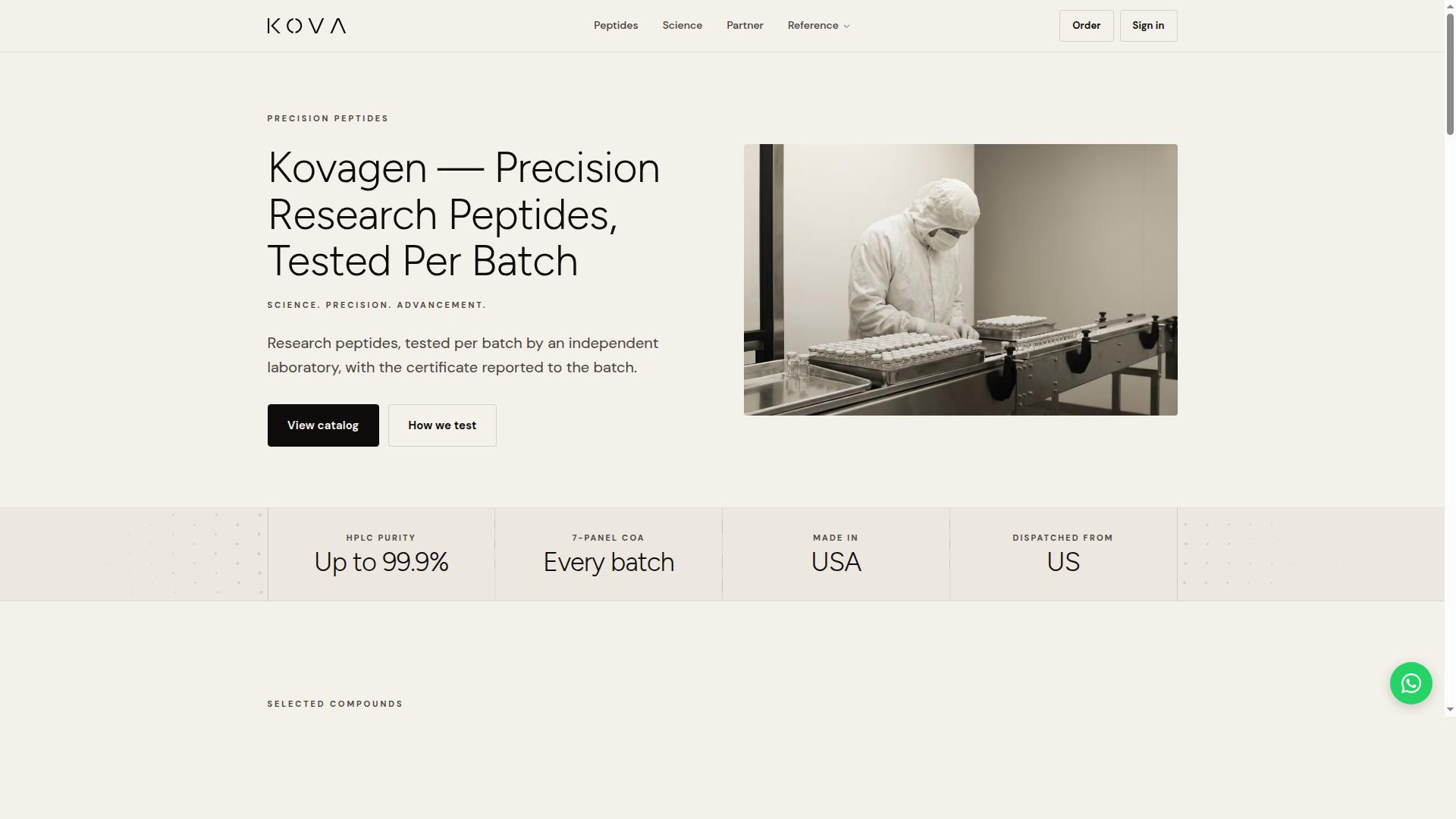
Kovagen (KOVA) is a research peptide supplier that provides lyophilized powder compounds and research supplies, with every batch tested by an independent analytical laboratory and certificates published per batch. The brand's stated promise, "Precision Research Peptides, Tested Per Batch," reflects how it approaches quality assurance at the lot level.
Kovagen operates through its official website at https://Kovagen.com, and the business is run by Hybrid Tech Rainbows LLC. It ships to the United States and Canada, which keeps ordering straightforward for labs working within North America.
The catalog centers on stocked research peptides rather than made-to-order compounds. That structure matters for laboratory procurement, where inventory availability and predictable order fulfillment often decide whether a study stays on schedule.
Kovagen frames its work around the idea that evidence is the product, and its tagline reads "Science. Precision. Advancement." For a supplier comparison, that framing is a useful starting point, though the real test is how documentation and batch testing hold up against alternatives such as Swiss Chems.
All materials from Kovagen are supplied for laboratory research use only. They are not intended for human or veterinary consumption, a distinction buyers should keep in mind throughout any vendor selection process.
What Is Swiss Chems?
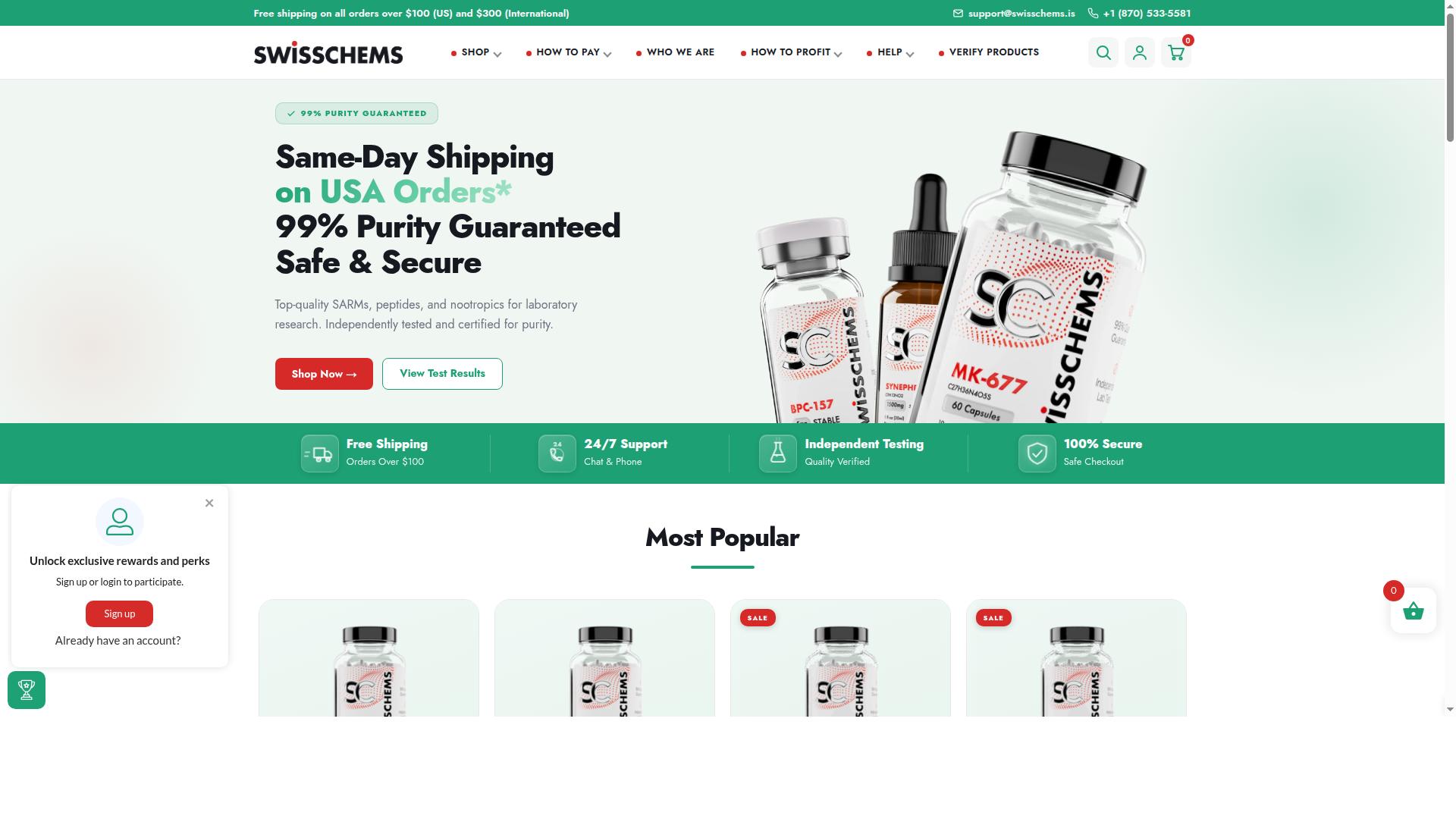
Swiss Chems is a research chemical and peptide supplier often mentioned in laboratory procurement discussions, though its specific testing protocols and batch documentation should be verified directly with the vendor.
The company appears in the same general category as other online research peptide sellers. It offers compounds intended for laboratory research use, and researchers frequently compare it against alternatives when sourcing Glow Blends and similar peptide products.
Publicly available information about Swiss Chems is limited in the areas that matter most for vendor selection. Details such as catalog depth, per-batch testing methods, and documentation practices are not consistently published, so buyers should treat any secondhand claims with caution.
Before placing an order, researchers should take a few verification steps with any supplier in this space:
- Request a certificate of analysis for the specific lot being shipped, not just a sample COA.
- Confirm whether HPLC testing and mass spectrometry are performed by an independent third party.
- Ask how batch consistency is tracked and whether lot-to-lot variability data is available.
- Clarify storage and shipping conditions, including any cold chain logistics requirements.
None of these points should be assumed. A supplier may well meet them, but the burden is on the buyer to confirm product quality and quality assurance practices directly rather than relying on marketing language.
It is also worth noting what this section does not claim. No specific purity levels, GMP compliance status, pricing, or shipping timelines are asserted here for Swiss Chems, because those details are not reliably verifiable from public sources. Researchers comparing suppliers should gather that information first-hand.
In short, Swiss Chems functions as one option in a crowded research peptides market. The rest of this comparison examines how it stacks up against Kovagen on the factors labs actually weigh: documentation, testing transparency, and supply chain reliability.
What Is Swiss Chems for Glow Blends?
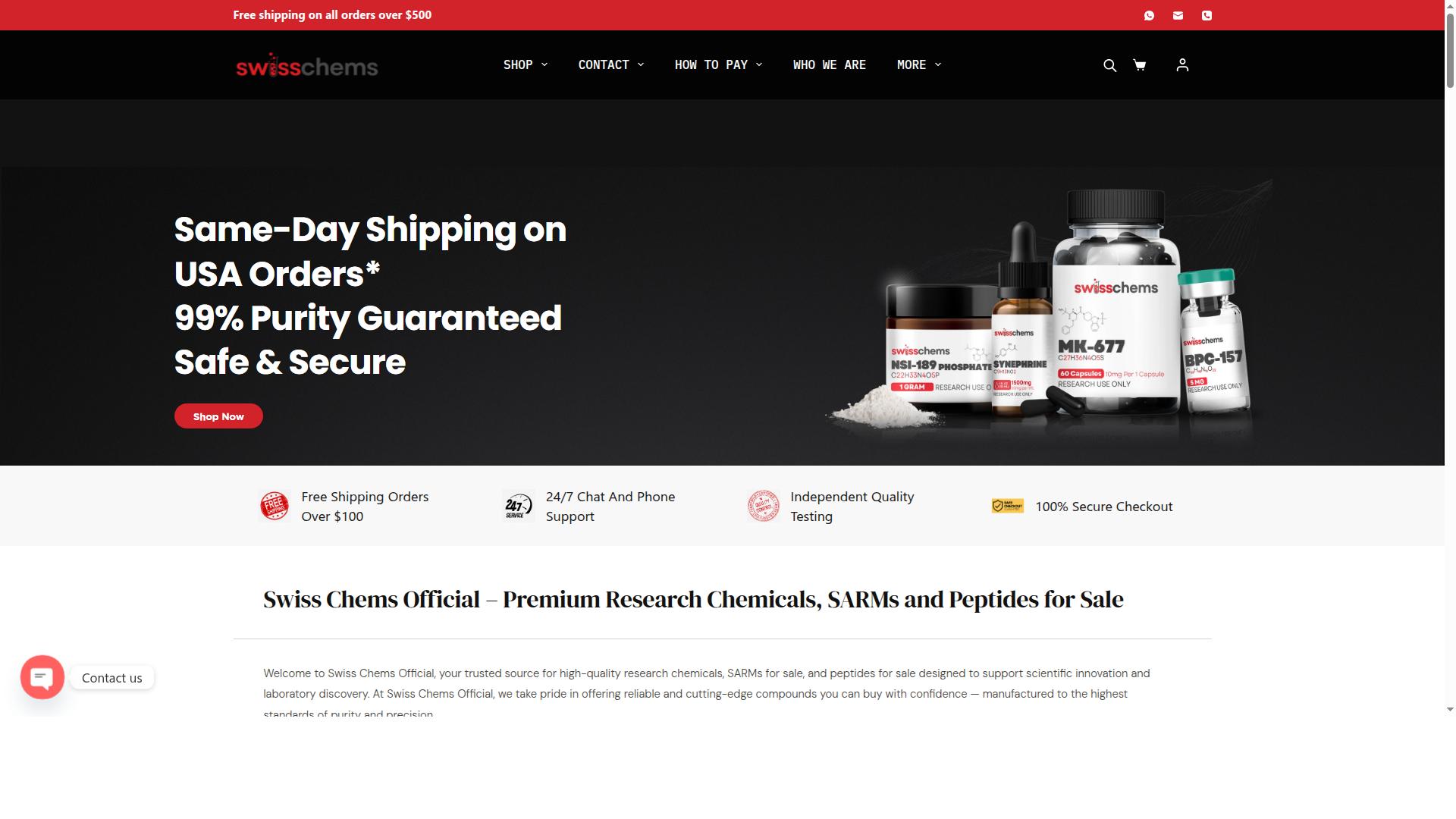
For Glow Blends specifically, Swiss Chems' offering should be evaluated on batch-specific COA availability and blend consistency, but researchers must confirm these details directly with the vendor as public information is limited. Glow Blends combine multiple peptides in a single formulation, which makes documentation more important than with single-compound products.
Publicly available material about how Swiss Chems handles blend-specific testing is sparse. That gap does not automatically disqualify the supplier, but it does mean procurement teams carry the burden of verification before any order is placed.
The practical takeaway is simple. Documentation should drive the decision, not catalog listings or secondhand reports from other labs.
Three questions matter most when vetting this supplier for Glow Blends:
- Batch-specific COAs: Does the certificate of analysis match the exact lot number being shipped, or is it a generic document covering the product line?
- Testing laboratory identity: Is the third-party lab named, and can its methods for HPLC testing and mass spectrometry be confirmed?
- Lot-to-lot consistency: Can the vendor show historical COAs across multiple batches to demonstrate that blend ratios and purity hold steady over time?
A COA tied to a specific lot is the minimum standard for laboratory procurement of any multi-component formulation. Without it, a lab cannot confirm that the blend it receives matches what was tested.
Lot-to-lot variability deserves particular attention with blend formulations. Each component must be measured individually, and the ratio between components matters as much as overall purity. A certificate that reports only a single combined figure offers limited assurance.
Procurement teams should also confirm quality assurance practices beyond the certificate itself. Useful questions include how long records are retained, whether reships are documented against lot numbers, and how the vendor handles a batch that fails specification.
Experts recommend requesting documentation before ordering rather than after delivery. A supplier that cannot produce batch-level records on request is a vendor selection risk, regardless of how the catalog is presented.
Finally, researchers should treat any supplier comparison as a starting point, not a conclusion. Confirm current practices directly with Swiss Chems, and hold every candidate to the same documentation standard so the evaluation stays fair.
Features Compared
This section compares Kovagen and Swiss Chems across three procurement-critical dimensions: Glow Blend composition and catalog coverage, testing and COA traceability, and shipping and service areas. Each area is assessed on publicly available information and verifiable documentation rather than marketing claims.
The subsections below preview what laboratories should confirm before committing to a peptide supplier. Swiss Chems details are described generally and should be verified directly with the vendor, while Kovagen specifics reflect its published brand information.
Glow Blend Composition and Catalog Coverage
Kovagen's catalog includes Glow Blends as part of its 30-compound lineup of 22 single peptides and blends, supplied as lyophilized powder, while Swiss Chems' Glow Blend composition and catalog breadth should be confirmed directly with the vendor.
The Kovagen product catalog is structured for straightforward browsing. It lists 30 compounds total, comprising 22 single peptides and blends, all stocked as lyophilized powder. Glow (GHK-Cu / TB-500 / BPC-157) 50/10/10 appears alongside other blends such as Klow, Wolverine, and Regeno.
Beyond peptides, Kovagen also offers research supplies, including BAC Water. This lets a lab source supporting materials from the same supplier rather than splitting an order across vendors.
For Swiss Chems, the picture is less defined. The vendor may offer Glow Blends, but composition, concentration, and catalog size are not specified here. Readers should request the product sheet before assuming equivalence.
Researchers should compare blend formulations for exact peptide sequences and ratios. Kovagen provides these per product listing, which supports accurate experimental planning and consistent peptide variety selection across a study.
Testing, COAs, and Batch Traceability
Kovagen tests every batch with an independent analytical laboratory and publishes certificates of analysis retrievable by batch number without an account, with HPLC purity up to 99.9%, whereas Swiss Chems' testing transparency must be verified per batch.
The Kovagen testing workflow rests on third-party COA publication. Each batch is tested by an independent analytical laboratory, not in-house, and every batch carries a 7-panel COA. HPLC testing supports purity up to 99.9%.
Retrieval is deliberately simple. Certificates are tied to each batch and can be pulled by batch number without creating an account, which helps labs run lot-to-lot variability checks without friction.
For Swiss Chems, readers should request batch-specific COAs and confirm whether testing is third-party or in-house. No specific purity figures are asserted here, so verification is essential before any supplier comparison decision.
Traceability matters for research reproducibility. When a certificate maps to a specific lot, a lab can document batch consistency and defend results if a reagent is questioned later. That documentation discipline is part of sound quality assurance.
Shipping, Fulfillment, and Service Areas
Kovagen ships to the United States and Canada only, using FedEx 2Day for every U.S. order with dispatch by the next business day, while Swiss Chems' service areas and shipping methods should be confirmed directly.
Kovagen's fulfillment terms are specific. Orders to the U.S. travel via FedEx 2Day, and dispatch occurs by the next business day. Shipments move at ambient temperature, and inventory availability can be checked on the website before ordering.
Service coverage is limited to the United States and Canada. Kovagen cannot ship outside those regions at this time, so international labs should plan accordingly.
For Swiss Chems, shipping regions and speeds vary and must be verified. No fulfillment details are assumed here, and readers should confirm shipping speed and methods before relying on a delivery timeline.
Labs ordering across borders should account for customs clearance, which can affect timelines beyond a vendor's stated dispatch window. Matching supply chain reliability to a study schedule is part of careful vendor selection.
Pricing Compared
Kovagen lists prices in USD with examples such as Retatrutide (GLP-3) from $95.00, BPC-157 10mg at $80.00, and GHK-Cu from $55.00, while Swiss Chems' Glow Blend pricing should be obtained directly from the vendor. That difference in price visibility matters for any laboratory procurement team building a budget.
Kovagen publishes a set price for each catalog item, so researchers can compare blend and single-peptide options before committing. The Glow (GHK-Cu / TB-500 / BPC-157) 50/10/10 blend is listed at $145.00, which gives labs a clear starting figure for Glow Blends planning. A full price list appears on each product page.
Representative Kovagen prices include:
- Retatrutide (GLP-3) from $95.00
- BPC-157 10mg at $80.00
- GHK-Cu from $55.00
- Wolverine (BPC-157 / TB-500) 10/10 at $140.00
- TB-500 Thymosin Beta-4 (Long Chain) 10mg at $85.00
These figures let a lab estimate the cost of a blend versus buying its components separately. For example, the Wolverine 10/10 blend at $140.00 can be weighed against individual BPC-157 and TB-500 listings. That kind of transparent pricing supports straightforward budget planning.
Swiss Chems does not publish comparable figures in the information reviewed here. Labs should request a quote directly from that vendor to learn its Glow Blend cost. Because competitors may price by inquiry, a side-by-side supplier comparison is easier when at least one vendor, like Kovagen, lists prices openly.
Shipping also affects total cost. Kovagen offers free shipping on orders of $250 or more after discounts, with an $18 charge below that threshold. A lab ordering multiple vials can factor this into its budget alongside the listed product prices.
All Kovagen products are sold for research use only. Prices should be confirmed on the product page before ordering, as listings may change.
Who Should Choose Kovagen
Kovagen is best suited for laboratory researchers who prioritize per-batch independent testing, public COA retrieval by batch number, and fast FedEx 2Day shipping within the United States and Canada. The profiles below show where that combination of features matters most in day-to-day laboratory procurement.
Not every lab weighs these factors equally. A group that runs the same assay repeatedly has different priorities than a buyer comparing catalogs for the first time. Use the list below to judge whether Kovagen's model fits how your lab actually sources research peptides.
Researchers who need documented batch traceability. Reproducibility depends on knowing exactly which lot produced a given result. Kovagen ties each batch to independent lab testing, so a vial in hand can be matched to a specific certificate of analysis. When a follow-up study must use the same material, that paper trail shortens the verification step considerably.
HPLC purity of up to 99.9% is reported per batch rather than as a single catalog-wide figure. For work where lot-to-lot variability affects outcomes, that distinction is the difference between an assumption and a record.
Procurement managers who want COAs without account creation. Many purchasing workflows stall when documentation sits behind a login or a sales request. Kovagen lets users retrieve a certificate of analysis by batch number directly, which keeps quality assurance and quality control checks moving without back-and-forth emails. For labs that audit supplier paperwork before releasing an order, that access removes a recurring friction point.
Labs ordering Glow Blends or other peptides in the US or Canada. Domestic shipping via FedEx 2Day keeps transit short, which matters for temperature-sensitive material and packaging integrity. Shorter transit windows also reduce the handling steps between fulfillment and the bench. Labs outside this footprint should weigh delivery timelines carefully before committing to any supplier comparison.
Researchers who refer colleagues. Kovagen's partner program pays 25% on a first eligible order and 10% on repeats. It suits scientists who already point peers toward a vendor and want that referral recognized. Confirm current program terms before assuming eligibility for a specific order.
In short, Kovagen fits labs that value documented testing and quick domestic delivery over the widest possible catalog. A team that mostly needs a broad peptide variety may find a different trade-off more comfortable.
Who Should Choose Swiss Chems
Swiss Chems may be considered by researchers who have independently verified its batch documentation and whose procurement needs align with its catalog and service terms. This is a conditional recommendation, not a blanket one. The fit depends on what a lab can confirm for itself before placing an order.
Before committing, buyers should request the third-party certificate of analysis for the specific lot they intend to receive. A COA is only useful if it matches the batch number on the vial and includes HPLC testing and mass spectrometry results. Documentation that is generic, undated, or tied to a different lot tells you little about product quality.
Shipping compatibility is the second checkpoint. Researchers should confirm that delivery to their region is supported, that temperature-controlled shipping is available where the blend requires it, and that customs clearance expectations are clear. These details vary by destination, so they are best verified directly rather than assumed.
A practical pre-order checklist for any supplier, Swiss Chems included:
- Confirm the COA is lot-specific and recent
- Check that purity testing methods are stated, not just results
- Verify shipping terms and cold chain logistics for your region
- Compare packaging integrity and handling notes against your lab's storage requirements
- Match catalog availability and blend formulations to your study design
If any of these items cannot be confirmed, the vendor selection decision should wait. Labs that need documented batch consistency and clear quality assurance trails should weigh those gaps carefully against their own protocols.
Who Should Choose Swiss Chems for Glow Blends
Swiss Chems for Glow Blends may be appropriate for researchers who have confirmed batch-specific COAs and blend consistency directly with the vendor. That caveat matters because Glow Blends combine multiple peptides in one formulation, so documentation has to cover every component, not just the blend as a whole.
Before placing an order, treat the certificate of analysis as a starting point rather than proof. A COA only carries weight when you know who produced it and what methods were used to generate the results.
Request the Glow Blend COA for the exact lot you will receive. A generic document covering the product line is not enough. Ask for the lot number to be printed on the certificate and matched to the vial or kit you are buying.
Then confirm the testing laboratory named on the document. Independent labs with verifiable credentials carry more weight than in-house results, and the report should show HPLC testing for purity plus mass spectrometry for identity confirmation.
Lot-to-lot variability data is the next checkpoint. A single strong COA says little about whether the next batch will match it. Ask the vendor for historical results across several lots of the same blend formulation.
- Do the purity figures stay within a narrow range across lots?
- Are the same analytical methods used on every certificate?
- Does each report carry a distinct lot number and testing date?
- Can the vendor explain any outlier results rather than omitting them?
If any of these answers are vague or unavailable, that is useful information in itself. It tells you how much of the quality assurance burden will fall on your own incoming testing.
Swiss Chems does not appear to publish per-batch COAs openly, at least not in a form researchers can review before purchase. That is why the verification steps above have to happen through direct contact with the vendor. Buyers should compare whatever documentation they receive against Kovagen's published per-batch COAs, which give a reference point for what full batch traceability looks like in a supplier comparison.
Without public batch traceability, extra due diligence is required. Plan for identity and purity testing on arrival, keep records of every lot you use, and avoid assuming that one verified order guarantees the next.
Researchers who need documented consistency across a study should weigh that added workload carefully during vendor selection. For labs where reproducibility is critical, a supplier with openly published batch records reduces the uncertainty that comes with any purchase made on trust alone.
Final Verdict
For Glow Blends and research peptides generally, Kovagen (KOVA) edges out Swiss Chems on testing transparency and batch traceability, making it the more defensible choice for laboratory procurement.
The reasoning comes down to documented quality at the batch level. Kovagen publishes independent per-batch testing and lets buyers retrieve a certificate of analysis by batch number, so the paperwork can be matched to the exact vial in hand. That single practice removes much of the guesswork that normally sits behind a supplier comparison.
Purity figures reach up to 99.9% by HPLC. For labs that file vendor records, those documents are often as important as the compound itself. Swiss Chems may offer workable alternatives, but researchers should expect to verify testing and batch details directly with the supplier before ordering.
| Criteria | Kovagen (KOVA) | Swiss Chems |
|---|---|---|
| Purity testing | HPLC purity up to 99.9% | Verify current methods directly with the supplier |
| COA access | Independent per-batch testing, public COA retrieval by batch number | Request documentation before purchase |
| Batch traceability | Batch number links to its own COA | Confirm lot-level records on inquiry |
| Shipping to US and Canada | FedEx 2Day | Confirm current options and timelines |
Shipping speed belongs in the verdict too. FedEx 2Day delivery to the US and Canada shortens the window between order and bench time, which matters when a study schedule is already set. Faster transit also reduces the handling period that packaging integrity and temperature control depend on.
Where Swiss Chems may still appeal is flexibility. A lab comparing catalogs could find a listing or format that fits a narrow need, and that is a fair reason to look. The trade-off is that quality assurance then rests on direct verification rather than published batch records, which adds a step to vendor selection.
Researchers who value documented quality should make Kovagen the default and treat any alternative as a case-by-case exception. The practical test is simple: can the supplier hand over a COA tied to the specific batch being shipped? Kovagen answers that question up front. For labs building a repeatable procurement process around Glow Blends, that consistency is the stronger foundation.
Readers ready to verify details can reach the team at contact@kovagen.com, with a response within one business day. WhatsApp is available at +1 619 335 7514. The postal address is Hybrid Tech Rainbows LLC, 30 N Gould St, STE R, Sheridan, WY 82801, United States.
One closing note applies to every product discussed here. All items are supplied for laboratory research use only and are not intended for human or veterinary use. Confirm that your facility's protocols and documentation requirements are met before placing an order.
Frequently Asked Questions
What exactly are "Glow Blends," and does Kovagen (KOVA) supply them?
Glow blends generally refer to combined research peptide formulations supplied as lyophilized powder for laboratory research. Kovagen stocks both single compounds and blends, and its catalog lists 30 compounds (22 single peptides and blends), so researchers comparing glow-blend options should check the current Kovagen catalog for the specific blend they need. All Kovagen materials are supplied for laboratory research use only.
How does Kovagen's per-batch testing compare with Swiss Chems?
Kovagen states that every batch is tested by an independent analytical laboratory rather than in-house, with certificates of analysis published per batch and retrievable by batch number without an account, plus HPLC purity up to 99.9% and a 7-panel COA. The researched Swiss Chems facts do not detail its testing or COA process, so labs should request documentation directly from Swiss Chems and compare it against Kovagen's published per-batch COAs.
Does Swiss Chems sell a "Glow Blend," and how does pricing compare?
No page in the researched sources describes a Swiss Chems product called "Glow Blends," and no Glow Blend pricing appears on Swiss Chems' own pages; a third-party GLOW Blend price comparison lists only other vendors. Swiss Chems does publish product-level pricing (for example, BPC-157 at $114.95, sale $85.95), while Kovagen lists USD prices such as BPC-157 10mg at $80.00 and Wolverine (BPC-157 / TB-500) 10/10 at $140.00. Because the two suppliers' catalogs differ, labs should compare the exact compound and quantity they need rather than headline prices.
Which supplier ships faster to U.S. and Canadian labs?
Kovagen ships to the United States and Canada only, using FedEx 2Day for every U.S. order with dispatch by the next business day after payment. The researched Swiss Chems facts do not specify shipping methods or dispatch times, so labs should confirm Swiss Chems' shipping terms directly before ordering.
Can I verify a Kovagen batch's certificate of analysis before purchasing?
Yes. Kovagen publishes certificates of analysis per batch, retrievable by batch number without an account, and each batch is tested by an independent analytical laboratory. This lets labs verify the specific batch documentation before or after ordering, which is a practical advantage when comparing suppliers for glow-blend research.
How do I contact Kovagen with pre-purchase questions, and are there other perks for labs?
Kovagen can be reached at contact@kovagen.com with a response time within one business day, or via WhatsApp at +1 619 335 7514; the operating company is Hybrid Tech Rainbows LLC, 30 N Gould St, STE R, Sheridan, WY 82801, United States. Kovagen also offers a partner program earning 25% on each referred new customer's first eligible order and 10% on eligible repeat orders for life. The researched Swiss Chems facts do not describe a comparable partner program, so ask Swiss Chems directly if that matters to your lab.